Last night, Eyes on Animals observed the loading of turkeys using the TA800 catching machine from CMC-Industries. We were invited by Bram Godrie of GTC Technics and turkey farmer Dirk van der Sterren. The turkeys were kept according to the Beter Leven1-star criteria, which mainly means they had slightly more space and enrichment materials. In total, 3,500 turkeys (hens), each weighing around 9 kilos, were caught.
Catching machine owned by the farmer
The catching machine was owned by the farmer himself. He finds it a major advantage not to be dependent on external catching crews and to carry out the loading at his own pace, with extra attention to the animals.
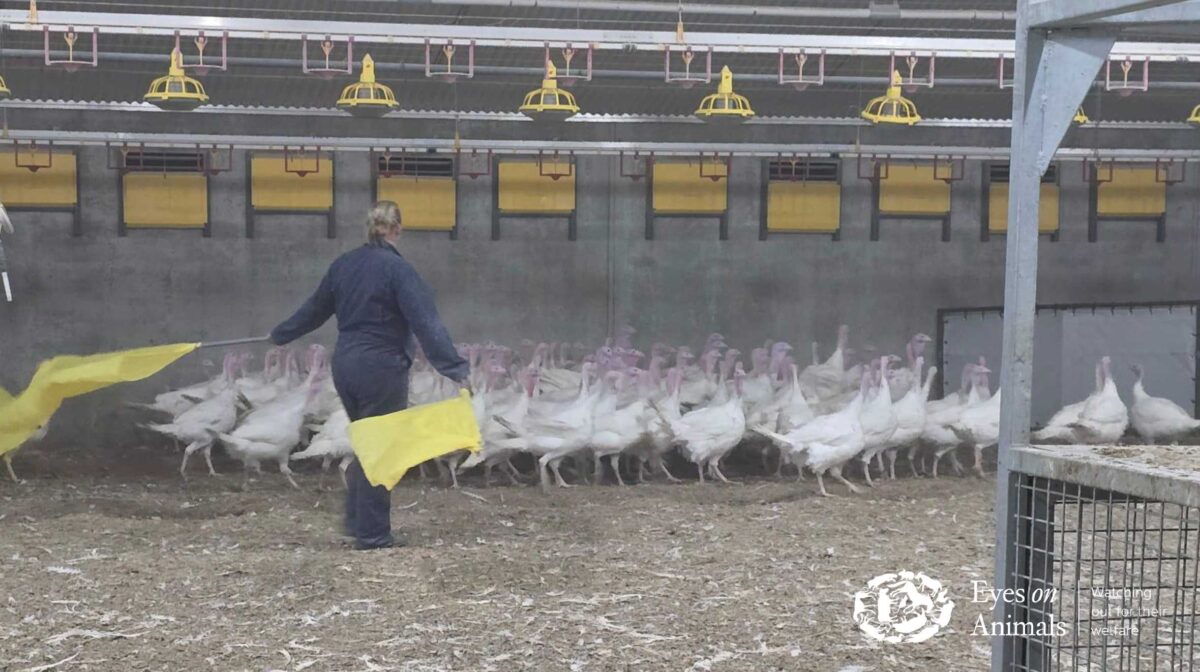
The process was carried out by two workers who herded the turkeys toward the conveyor belt and two who operated the machine. A part of the machine – the pre-loader – had been placed inside the barn two days earlier, so the turkeys could get used to it and experience less stress during catching. The machine runs on electricity and therefore produces relatively little noise.
Herding, catching and loading – mild stress moments but overall calm
The turkeys were herded to the conveyor belt in relatively small groups. The workers moved slowly and applied minimal pressure to reduce stress, using two homemade flag sticks to extend their reach. Remarkably, the animals moved along well and showed little visible stress. The process was therefore carried out neatly and calmly – a big difference compared to manual catching. The turkeys were also in good condition: their plumage was intact and they were walking well.
Once on the conveyor belt, the turkeys were moved through a tunnel into the truck parked next to the barn. This automatic transfer and loading caused mild stress at two points:
- when the turkeys had to move from the group into the narrower tunnel
- when the turkeys were placed into the transport containers.
At the point where the conveyor entered the container, it ran faster and was more slippery to prevent the animals from resisting and to avoid blockages. However, this speed caused some stress, and some turkeys ended up on their backs. Fortunately, the staff were alert and immediately placed these birds upright again. Constant attentiveness is therefore crucial at this stage – also to prevent turkeys from falling out of the container during loading.
Closing some of the containers required considerable force, which meant it was not always possible to do so gently. This created a risk of birds being bumped or toes being pinched. We can also imagine that male turkeys – being more than twice as heavy and much taller – experience more stress at the moments when they have to enter the narrower tunnel or the containers.
Less risk of fatigue or desensitisation
A major advantage of mechanical loading compared to manual catching is that fatigue or emotions of workers have far less impact on animal welfare. This is especially important with heavy turkeys, with hens weighing around 10 kilos and males around 21 kilos.
On this farm, the turkeys were not all loaded on a single evening, but spread out over several days. This kept the workload manageable, which greatly helps maintain the quality of the process. Even though the machine does most of the work, the process still demands constant attentiveness and care. People simply cannot remain sharp all night long.
Use of a spring-operated captive bolt device
The farmer used a spring-operated captive bolt device from Dick to stun sick or injured turkeys, after which cervical dislocation was applied. We find it very positive that a stunning device is used, since cervical dislocation without prior stunning is painful and does not cause immediate unconsciousness. However, we had some doubts about the effectiveness of this device. We will investigate this further and keep the farmer informed.
Finally, we spoke with the workers about the transport of injured, sick or lame turkeys. According to the law, such animals may not be transported, but in practice there still seems to be some uncertainty about this. We believe it would be useful to draw up a sector-wide protocol, so that every turkey farmer knows clearly which animals may or may not be transported.
Openness and cooperation
We would like to warmly thank Bram Godrie, the farmer and his staff for their openness and willingness to share this process with us. They were receptive to reviewing the critical moments together and to discussing possible improvements. We greatly value this transparent attitude. We also found that the work was carried out neatly, and that careful thought had gone into both the herding and the use of the machine.