Recently, Eyes on Animals and Animal Welfare Foundation (AWF) monitored two transports of Dutch piglets to a slaughterhouse in Croatia. These were “unwanted piglets” – young animals rejected for further fattening due to health problems or growth deformities, and therefore slaughtered prematurely. Many had umbilical hernias; others had bitten ears, abscesses, or growth abnormalities such as “dolphin heads.”
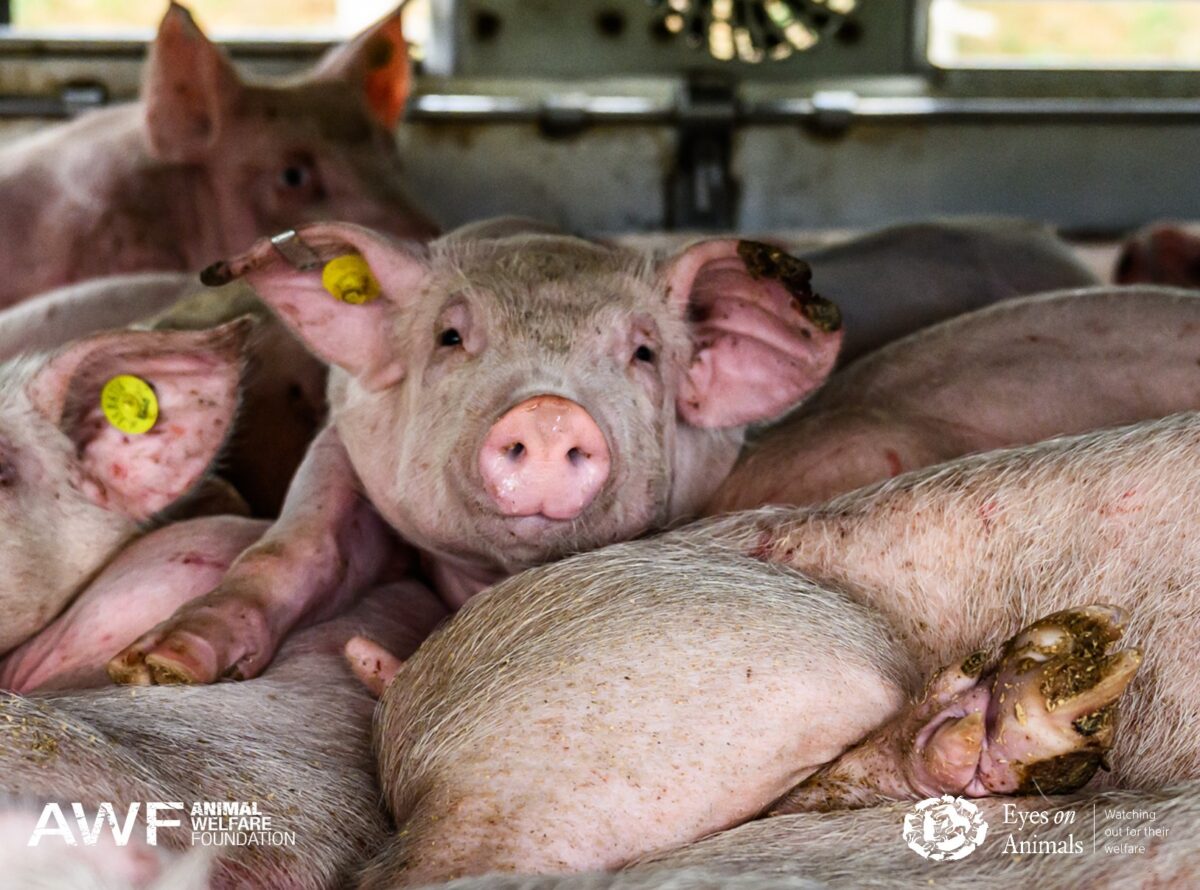

Every week, thousands of such rejected piglets are exported from the Netherlands to slaughterhouses in countries including Croatia, Italy, and Spain, where they are roasted on a spit and sold as a “delicacy.”
Serious shortcomings during transport
One of the two transports, carrying 926 piglets, was spotted by us at a petrol station in the south of the Netherlands. We trailed it to its final destination: a slaughterhouse in Netretić, Croatia. Together with AWF, we documented several serious welfare violations:
- Several compartments were severely overcrowded, with piglets forced to lie on top of and against each other, making it difficult for them to reach the water nipples. For animals with large umbilical hernias, this poses a serious risk: the swelling can easily be trampled and ruptured by the weight of others. In contrast, other compartments had a much lower loading density, indicating a poor distribution of the animals.

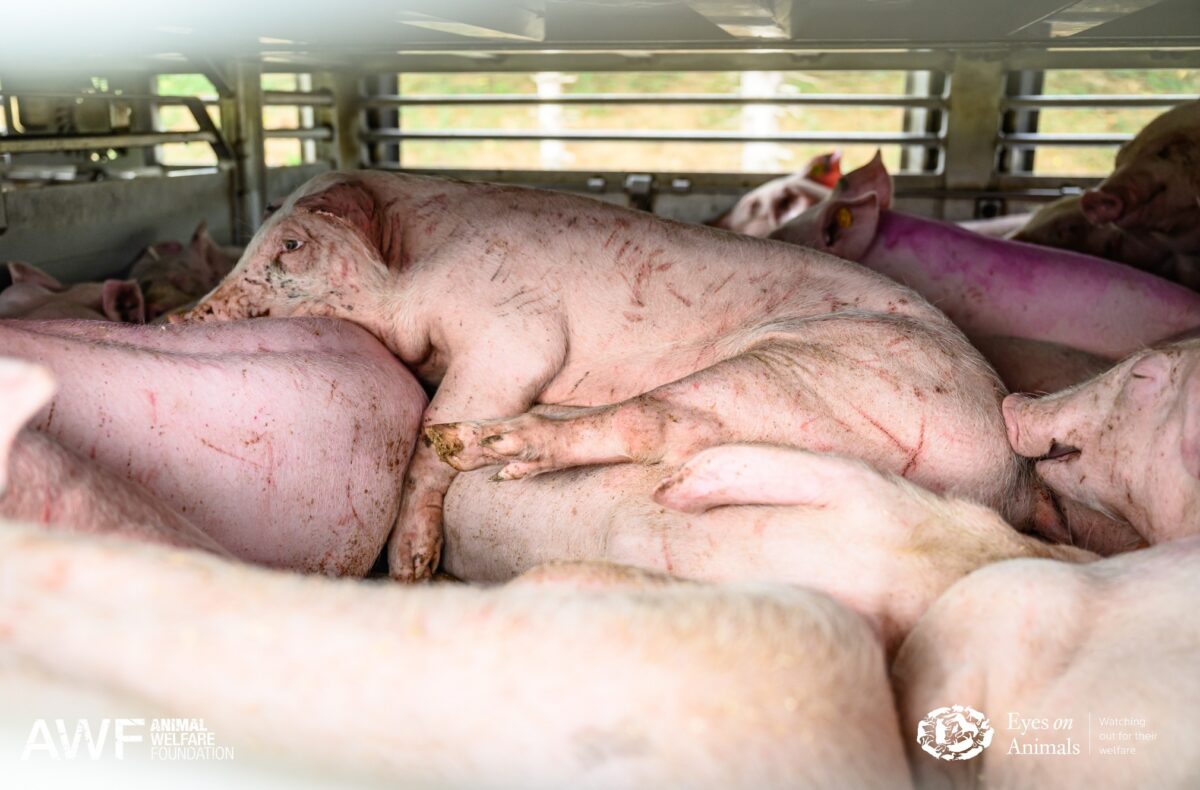
- The drinking water system was switched off for the entire journey. The drivers took no breaks to provide water and did not check on the animals’ welfare during the trip.
- Upon arrival, the piglets had to wait another 1.5 hours in the truck because the slaughterhouse was still closed. Only then was the water system turned on. The piglets were visibly desperate for water, climbing over each other and fighting for access.
- The nipple drinkers were poorly positioned: much water was wasted, and the piglets struggled to drink because the nipples were set too low and faced the wrong way.
- At least one piglet was dead on arrival. Several others were visibly weakened.


- Many piglets had large umbilical hernias, some with wounds on them. We also saw many piglets with scratches and wounds – the result of fights after animals from different groups were mixed.
The total transport time from the assembly centre in the Netherlands to unloading at the slaughterhouse in Netretić was 18 hours: 16.5 hours on the road plus 1.5 hours waiting in front of the slaughterhouse.

Dead piglets from Lunteren assembly centre
The second transport we inspected was seen arriving at the same slaughterhouse in Netretić, having originated from the assembly centre in Lunteren. We witnessed the unloading, during which at least five dead piglets were thrown from the truck. They had not survived the journey. Lunteren has a history of transporting unfit animals.
Croatian slaughterhouses express concerns
While in Croatia, Eyes on Animals also visited other slaughterhouses that receive Dutch piglets. They confirmed our concerns. One slaughterhouse reported that Dutch drivers routinely load far too many piglets: where 700–800 would be appropriate, trucks often carry 900–1,000. Another slaughterhouse said it had stopped importing Dutch piglets altogether because of the poor condition in which they arrive.
Inadequate NVWA inspection
Eyes on Animals has submitted a formal enforcement request to the Dutch Food and Consumer Product Safety Authority (NVWA), which approved both transports for export. We have also requested that export inspections be tightened, as these transports should never have been approved given the animal welfare risks. In our view, there was insufficient inspection of the animals’ condition and the transport circumstances. The problems we documented – together with the concerns voiced by Croatian slaughterhouse staff – point to systemic weaknesses in oversight.
We urge the NVWA to:
- Establish clear loading density standards for slaughter piglets, ensuring that all animals can lie down simultaneously and have access to drinkers, in line with EU Regulation 1/2005. Special consideration should be given to piglets with umbilical hernias, as they cannot lie comfortably on their belly and therefore require extra space to lie on their side.
- Physically inspect the loading density in each compartment, rather than relying only on paperwork;
- Conduct stricter inspections of piglets’ physical condition before departure and upon arrival at the slaughterhouse. Journey logs should be actively reviewed and used for enforcement.
- Check the functionality and effectiveness of the water system;
- Monitor handling practices during loading – rough treatment and inadequate facilities are still too often accepted.
Call to end the export of young, vulnerable piglets
In our view, piglets rejected for further fattening due to health problems or growth deformities should be slaughtered locally, with minimal stress. Transport should be limited to a maximum of four hours and be direct – from farm to slaughterhouse – without detours via assembly centres, where piglets often have to wait another 0.5 to 1.5 days in substandard conditions.
In addition, the number of piglets with abnormalities must be reduced. Many problems, such as umbilical hernias and deformed backs or heads, are the result of one-sided genetic selection for production traits. Small-scale pig farms with healthy breeds have far fewer such abnormalities, can devote more time to individual care, and often slaughter their pigs locally at small slaughterhouses. This should become the norm.
Read our report on the welfare of slaughter piglets here >>