• Skip to primary navigation
  • Skip to main content
  • Skip to primary sidebar
  • Skip to footer
  • EYES ON ANIMALS – Watching out for their Welfare
  • English
  • Nederlands
  • Deutsch

Eyes on Animals

Watching out for their Welfare

  • Facebook
  • Instagram
  • Twitter
  • YouTube
DONATE
  • About us
    • What we do
    • Our team
    • Key Figures
    • Our Vision
    • Contact
  • News
    • Latest news
    • Good news
    • Bad news
    • Featured news
    • Newsletter
  • Inspections
    • Farms
    • Markets
    • Transports
    • Slaughterhouses
    • Special projects
    • Other
  • Training
    • Police
    • Truck drivers
    • Poultry-catchers
    • Slaughter personnel
    • Training Material
    • Request a training
  • Industry Tips
    • Animal transport
      • Cattle
      • Pigs
      • Poultry
    • Slaughterhouses
      • Cattle
      • Pigs
      • Poultry
      • Ritual slaughter
    • Educational videos
  • Publications
    • In the media
      • Print
      • Television
      • Radio
      • Videos
    • Newsletters
    • Special reports
    • Training Material
    • Annual reviews
  • Help us
Home » Our inspections » Heatstress-inspections at pig slaughterhouse VION in Apeldoorn (NL)

Heatstress-inspections at pig slaughterhouse VION in Apeldoorn (NL)

July 19, 2022

Today we made an unannounced visit to a pig slaughterhouse owned by VION in Apeldoorn in connection with the extreme hot weather. VION immediately made time to show us around. We checked the condition of the pigs (inside the trucks, under the canopy and whilst unloading) and measured the temperatures. The canopy was constructed in 2021, following our advice. Prior to that all trucks stood in the sun whilst waiting to be unloaded. Under the canopy it is a few degrees cooler then outside it. However, the canopy is not big enough, as it only accommodates two trucks. The trucks were also parked too close together, preventing natural air flow. The pigs in the trucks showed a lot of heat stress. On top of that, one or two trucks were outside the canopy. Although they were parked  next to a wall (some shade) the sun was beating directly on the roof. 

Pigs in the truck suffered from severe heat stress. The respiratory rate was above 100 per minute

We noted the waiting time of two trucks (from arrival to unloading). Truck 1 stood still for 80 minutes under the canopy. Truck two, with the sun beating fully on its roof, stood still for no less than 120 minutes. With temperatures of 35-38 degrees in direct sun, and humidity at 30%, we find these long waiting times completely unacceptable. 
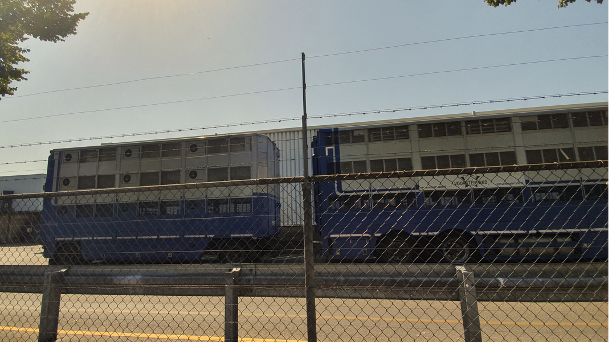
One of the loaded trucks stood outside for 2 hours with the sun beating down on its roof. 

There was also an inadequate number of fans under the canopy. Our advice is to place more fans  at all loading levels  so that the first and second loading floors also receive good ventilation. VION stated they will get to work on remedying this. They are also going to look at how to reduce the waiting time and create additional shaded areas. Until these recommendations have been implemented, we feel VION should instruct the drivers to keep the trucks moving. This is a challenge however, as drivers are reluctant to do this because of fuel costs.

Unloading in general was done well. VION in Apeldoorn only allows plastic bags to be used as a herding tool whilst unloading. We think this is very positive. Bags only make a little noise and can’t be used to hit animals with. Also, at the end of this month, a roof will be built so that trucks unloading are positioned in the shade and pigs are not blinded by the sun shining into the trucks. 

We observed the unloading of two trucks. In one truck (in which we witnessed pigs suffering severe heat stress), one pig had died. The animal had purple spots on its neck, a sign that it had likely suffocated from the heat. Two other pigs had collapsed and were unable to walk (organ failure); their suffering was ended on the spot using an electrical stunner and then bled out. 

The last truck was unloaded at 13:10. Many slaughterhouses ceased work earlier today, because the afternoon temperature in the shade was expected to be above 35 degrees. This is when transport is prohibited. But our observations (a lot of heat stress, exhausted pigs and one dead pig) show that transport should be forbidden way before that. We suggest a maximum of 27 degrees because this equates to approximately 32 degrees in direct sun. 

We appreciate the transparent approach of VION Apeldoorn; the fact that they allowed us access to all areas on short notice is very commendable. It is also very positive that they  will action our recommendations. We do however feel that measures to reduce heat stress should have been taken way earlier.  

  • share 
  • share 
  • share 
  • save 
  • email 

Filed Under: Our inspections, transport Tagged With: animal transport, animal welfare inspection, live animal transports

Primary Sidebar

Search

Featured

Regional slaughterhouses are disappearing — and animals are paying the price

Across the Netherlands, regional slaughterhouses are disappearing at an alarming pace. Not because … [Read More...] about Regional slaughterhouses are disappearing — and animals are paying the price

Featured

Injured sows at Lunteren assembly centre: NVWA investigation ruled inadequate

January 29, 2026

The Dutch Trade and Industry Appeals Tribunal (College van Beroep voor het Bedrijfsleven, CBb) has … [Read More...] about Injured sows at Lunteren assembly centre: NVWA investigation ruled inadequate

Our most recent newsletter

Dear friends,

A couple of years ago, while I was giving a talk at an animal welfare conference in the UK, an anthropologist from the University of Cambridge approached me. She conducts research in Mongolia and asked whether — if she could secure funding — we would be willing to help animals there. Where there is a will, there is a way, so I said yes to Liz!

Read more…

Subscribe to our newsletter

Subscribe

* indicates required

Eyes on Animals op X

cor10792734 Cor @cor10792734 ·
7 May

De schade is heel groot.' Vooral dieren die zich moeilijk kunnen verplaatsen, worden hard getroffen. 'Niet alles is even snel of kan vliegen. Veel kruipende dieren zijn de dupe, bijvoorbeeld slangen kunnen vaak niet snel genoeg wegkomen.' #bosbrand 🔥💀

Reply on Twitter 2052268565567341038 Retweet on Twitter 2052268565567341038 4 Like on Twitter 2052268565567341038 8 Twitter 2052268565567341038
eyes_on_animals Eyes on Animals @eyes_on_animals ·
20h

Gisterenavond zond de Duitse tv-zender ARD in het actualiteitenprogramma Plusminus een indringende reportage uit over het lot van veel Duitse kalveren die naar Nederland worden geëxporteerd voor de productie van wit kalfsvlees.Met beelden van EonA en interview met onze directeur.

Reply on Twitter 2052426207682043995 Retweet on Twitter 2052426207682043995 23 Like on Twitter 2052426207682043995 34 Twitter 2052426207682043995
eyes_on_animals Eyes on Animals @eyes_on_animals ·
20h

🐖 Ondertussen bij onze Zuiderburen: Brandweer Westhoek redt 19 varkens uit ingestorte stalvloeren in Oostvleteren en Torhout | VRT NWS Nieuws #varkens #mest

Reply on Twitter 2052420869637435800 Retweet on Twitter 2052420869637435800 6 Like on Twitter 2052420869637435800 12 Twitter 2052420869637435800
Load More...

ANBI

Latest news

Meat printer prints plant based meat

NOS-news: The meat printer

October 13, 2022

Veggie burger

Vox: Plant-based meat is better for the planet

November 18, 2021

All Future Vision news

Footer

Donate with Paypal

Paypal Eyes on Animals
One-time donation:
Monthly donation:

Reading Material

  • In the Media
  • Newsletters
  • Special EonA reports
  • Legislative texts
  • ANBI

Our Amsterdam Office

Amsterdam House Hotel
Eyes on Animals main office is in downtown Amsterdam, at the Amsterdam House Hotel. The generous and warm-hearted hotel owner donated to Eyes on Animals, free of charge, a beautiful room where our inspectors can work, hold meetings and store their material.

Copyright © 2026 · Eyes on Animals | Website by Webkompaan