This morning and early afternoon, Eyes on Animals visited the Westfort pig slaughterhouse in IJsselstein, the Netherlands. Due to the hot weather, approximately 1,000 fewer pigs were slaughtered today than usual.
At around 11:15 a.m., the temperature outside in direct sunlight was approximately 32°C, with a relative humidity of around 45%. Under the unloading canopy, the temperature was approximately 29°C, with a relative humidity of around 55%.
What we found positive
- Most pigs waited under the canopy for around 25 minutes before unloading. Although we believe that waiting times should ideally remain below 15 minutes during hot summer weather, waiting times at Westfort were clearly shorter than those we observed at the other large pig slaughterhouses we visited in recent weeks. One truck remained under the canopy for approximately one hour. In our opinion, this was too long, but it appeared to be an exception.
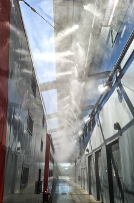
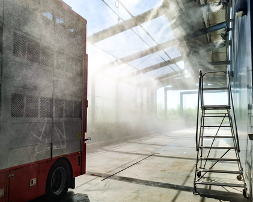
- Since our previous visit, Westfort has installed additional misting nozzles under the canopy. When combined with sufficient airflow, misting can significantly improve cooling for the pigs.
- On hot days, a dedicated staff member continuously monitors the welfare of pigs waiting under the canopy.
- A large mobile inspection platform is available, allowing staff to inspect pigs on all deck levels of the trucks. During our visit, we heard loud squealing coming from one of the upper compartments. A staff member immediately fetched the platform to investigate. It turned out that two boars were fighting. Fortunately, the fighting stopped after a few minutes.
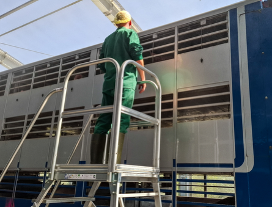
- Westfort immediately made time for us. We were allowed to take measurements, photograph the facilities, and openly discuss our observations. We greatly appreciate this transparent and cooperative attitude.
Areas for improvement
- In our opinion, there was still insufficient airflow under the canopy. Ideally, fresh air should move effectively through all compartments of the livestock trucks, on every deck. Good airflow helps pigs dissipate body heat and, especially when combined with misting, has a strong cooling effect. Relative humidity under the canopy was also somewhat higher than outside. Additional ventilation could help reduce this further.
- Since the trees alongside the road had to be removed, a considerable amount of direct sunlight now passes through the shade cloth. At the time of our visit, the temperature under the canopy was about 3°C lower than outside. This is certainly beneficial, but we believe the temperature could be reduced even further. Westfort informed us that on even hotter days the difference can increase to as much as 6°C.
- We observed two livestock trucks that were loaded at the normal stocking density, meaning no reduction had been made despite the hot weather. The drivers explained that the pigs had been loaded early in the morning when temperatures were still low. In our opinion, animals should not be loaded based only on the temperature at the time of loading, but also on the temperatures expected later during the journey. We will discuss this issue with Vee&Logistiek Nederland. Fortunately, the other trucks we observed had been loaded at lower stocking densities.
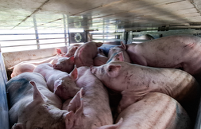

We also hope that slaughterhouses themselves will address drivers who transport pigs at normal stocking densities during hot weather. Westfort explained that they already compensate drivers financially for the pigs they leave behind because of the heat, helping to encourage compliance with the current heat protocol.
Positively, Westfort also indicated that it is willing to investigate further improvements to the unloading canopy, including installing additional fans and possibly testing a second layer of shade cloth.
Topics of shared concern
- We discussed the desire of slaughterhouses to start slaughter operations earlier on hot days without reducing the number of hours that official veterinarians are available, so that slaughter capacity can be maintained. An earlier start would allow pigs to arrive earlier, when temperatures are lower. At present, the possibilities for this are limited by the Dutch Food and Consumer Product Safety Authority (NVWA). Eyes on Animals understands this challenge. We also believe that pigs should be transported during the cooler hours of the day and are therefore committed to finding practical solutions that make this possible.
- We also discussed the increased risk of heat stress for pigs transported during a second trip on a hot day. By then, the truck itself has often become heated by the sun, creating more challenging conditions for the next group of animals.
- Finally, we discussed livestock trucks fitted with perforated metal side panels. Westfort recognizes that these so-called „mesh walls“ restrict airflow but currently sees few practical options to discourage their use. When these trucks have to wait, Westfort therefore prefers that they keep driving, allowing the airflow generated by the vehicle’s movement to provide at least some cooling.
We appreciate Westfort’s open attitude and its willingness to continue working together with us on practical solutions to further reduce heat stress in pigs during transport and at the slaughterhouse.