• Skip to primary navigation
  • Skip to main content
  • Skip to primary sidebar
  • Skip to footer
  • EYES ON ANIMALS – Watching out for their Welfare
  • Englisch
  • Holländisch
  • Deutsch

Eyes on Animals

Watching out for their Welfare

  • Facebook
  • Instagram
  • Twitter
  • YouTube
SPENDEN ABONNIEREN NEWSLETTER
  • Über uns
    • Was wir tun
    • Unser Team
    • Kennzahlen
    • Kontakt
  • Neuigkeiten
    • Letzte Neuigkeiten
    • Gute Nachrichten
    • Schlechte Nachrichten
    • Abonnieren Sie unseren Newsletter
  • Inspektionen
    • Landwirtschaftliche Betriebe
    • Märkte und Sammelstationen
    • Transporte
    • Schlachthäuser
    • Projekte
    • Veterinärinspektoren
    • Sonstige
  • Schulungen
    • Polizei
    • LKW-Fahrer
    • Schlachthofmitarbeiter
    • Geflügelfänger
    • Trainingsmaterial
    • Schulungsanfrage
  • Industrietips
    • Transport
      • Rinder
      • Schweine
      • Geflügel
    • Schlachtung
      • Rinder
      • Schweine
      • Geflügel
      • Rituelle Schlachtung
    • Schulungsfilme
  • Publikationen
    • In den Medien
      • Presse
      • Fernsehen
      • Radio
      • Videos
    • Newsletters (Englisch)
    • Spezialberichte
    • Trainingsmaterial
    • Geschäftsberichte
  • Helfen
Home » Mitteilung » Visit to a poultry slaughterhouse in Overijssel on a hot day

Visit to a poultry slaughterhouse in Overijssel on a hot day

13. August 2026

Today, we paid an unannounced visit to a broiler slaughterhouse in Overijssel, the Netherlands. With temperatures reaching around 30 °C, we wanted to see whether the slaughterhouse had taken measures to prevent heat stress as much as possible, such as reducing loading densities and carefully planning arrivals to avoid waiting times. We also wanted to see the facilities in the lairage.

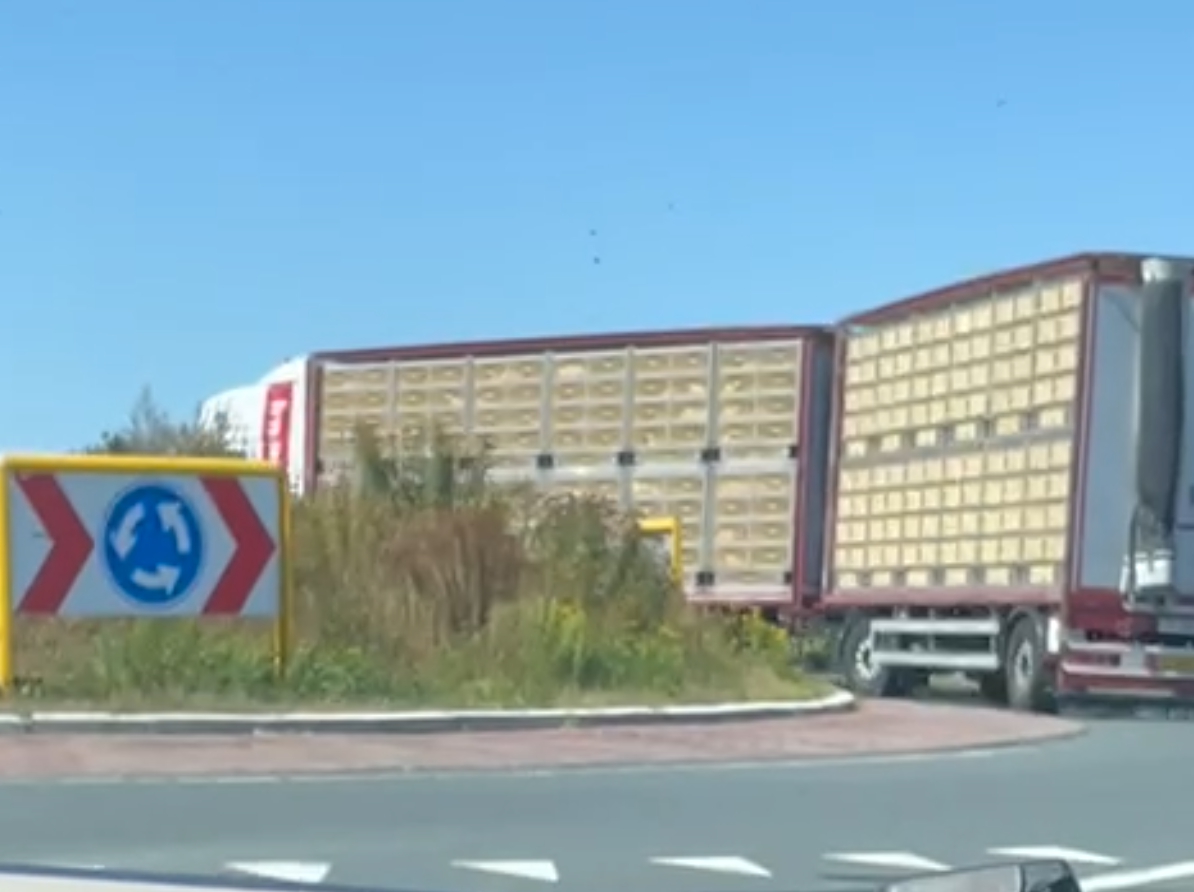
No stationary trucks, but one truck driving around
During our visit, we did not see any stationary trucks in the surrounding area, which was positive. However, we did see one truck driving around for approximately fifteen minutes before it was able to enter the premises. Keeping a truck moving is better than leaving it stationary, as the airflow provides some cooling. However, on hot days like this, trucks should ideally be able to enter the premises immediately upon arrival.
Very good lairage
When we arrived, staff welcomed us and took the time to show us around the lairage. Built last year, it is very modern and sets an example for many other slaughterhouses.

While the outdoor temperature was around 30 °C in the sun, the temperature inside the lairage was approximately 20 °C and could be lowered even further if necessary. Cooled air was directed towards the containers at different heights, ensuring that chickens at every level benefited from it. The manager told us that the lairage can also be heated in winter.

A minority of the birds had their beaks open and were breathing more rapidly, indicating mild to moderate heat stress, while many of the other birds were breathing normally. The signs of heat stress were presumably partly due to the birds having recently been transported in temperatures of up to 30 °C. Fortunately, the loading density in the container drawers was lower than usual.

The temperature and humidity in the lairage were shown on several displays on the wall. The lairage was also kept dark and illuminated with blue light, helping to keep the chickens calm.

Thorough inspection of the chickens
We saw an employee inspecting the chickens using a device specially designed for this purpose. It consisted of an illuminated camera mounted on a pole, with a screen positioned at the employee’s eye level showing the live camera feed. The pole also enabled him to properly inspect the chickens in the top drawers. We were impressed by this device.

Humane H2H device to quickly put suffering chickens out of their misery
The slaughterhouse also had an H2H Euthanizer, which is used to quickly put sick or injured chickens out of their misery. We support the use of this device because it renders chickens immediately unconscious and kills them, with minimal stress. The manager told us that the device is also available at their other slaughterhouses.

Chickens still arriving late in the afternoon
Later in the afternoon, when the temperature had reached approximately 34 °C, we saw that chickens were still being delivered to the slaughterhouse. In our view, chickens should no longer be caught and loaded at such temperatures. From next year onwards, transport at temperatures above 30 °C will no longer be permitted in the Netherlands, as animal welfare cannot be adequately protected under these conditions.

We thank the slaughterhouse for its openness, for allowing us to see everything firsthand, and for the innovative measures it has taken to reduce heat stress.


Filed Under: Inspektionen, Schlachthäuser Tagged With: animal welfare improvements, animal welfare inspection, slaughterhouse design, slaughterhouses

Primary Sidebar

Search

Featured

Improving broiler catching and loading: Eyes on Animals presents to the Better Chicken Business Network

Weeks of good stockmanship can be undone in just a few hours of rough catching and loading. Catching … [Read More...] about Improving broiler catching and loading: Eyes on Animals presents to the Better Chicken Business Network

Featured

Our 2025 Annual Review is now available

1. Juli 2026

Read about how your support enabled Eyes on Animals' teams to work in the field throughout 2025. Our … [Read More...] about Our 2025 Annual Review is now available

Unser neuste Newsletter

Dear friends,

After years of our fieldwork and our enforcement requests, the NVWA (the Dutch government inspection authority) is finally taking action.

The NVWA has made it clear to the entire calf export-import industry between Ireland and the Netherlands: transporting unweaned calves for more than 30 hours without milk will no longer be tolerated.

Read more…

Erhalten Sie unseren englischen Newsletter

Subscribe

* indicates required

Eyes on Animals op X

eyes_on_animals

Eyes on Animals

@eyes_on_animals ·
11 Okt.

🌈 Being queer is very normal and accepted amongst animals.
So Happy #ComingOutDay !

Queer Planet | Official Trailer | Peacock Original https://youtu.be/GikfSszcBHE?is=l0tECC2OerL-n7-Q via @YouTube

Auf Twitter antworten 2109253155183608135 Retweet auf Twitter 2109253155183608135 1 Auf Twitter liken 2109253155183608135 2 Twitter 2109253155183608135
eyes_on_animals

Eyes on Animals

@eyes_on_animals ·
10 Okt.

🔥🐓 18.000 kippen omgekomen bij stalbrand.
Arme dieren.https://www.omroepzeeland.nl/nieuws/18849505/18000-kippen-omgekomen-bij-grote-brand-in-kippenschuur-bij-biervliet #kippen #stalbrand

Auf Twitter antworten 2109024590941114832 Retweet auf Twitter 2109024590941114832 6 Auf Twitter liken 2109024590941114832 11 Twitter 2109024590941114832
faunabeschermin

De Faunabescherming

@faunabeschermin ·
8 Okt.

🕊️ @LucZeebroek @nrc

Auf Twitter antworten 2108289844937924635 Retweet auf Twitter 2108289844937924635 6 Auf Twitter liken 2108289844937924635 27 Twitter 2108289844937924635

Footer

Donate with Paypal

Paypal Eyes on Animals
Beträge (einmalig):

Beträge (monatliche Spenden):

Lesestoff

  • In den Medien
  • Newsletters
  • Gesetzestexte
  • Spezialberichte
  • ANBI

ANBI

Our Amsterdam Office

Amsterdam House Hotel
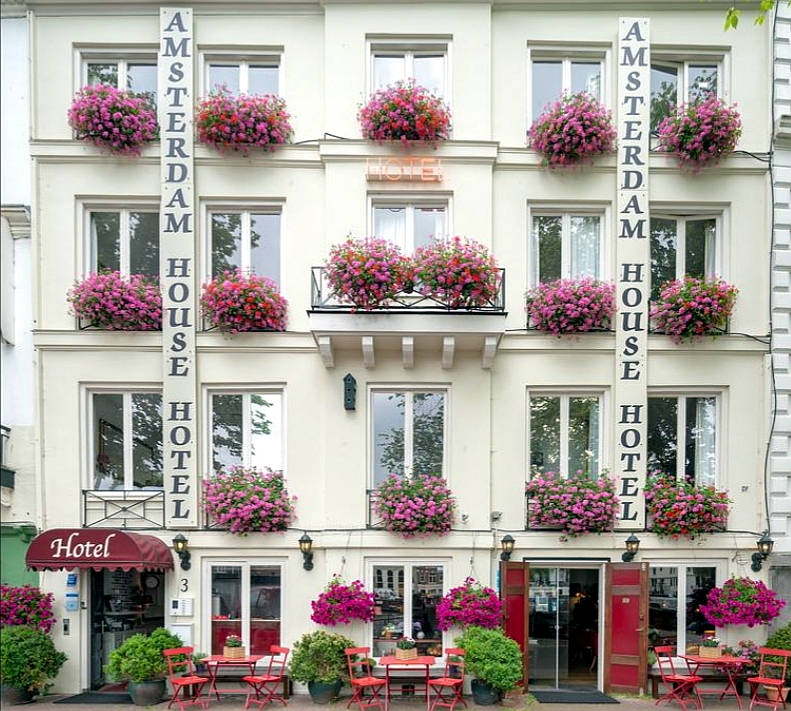
Das Büro von Eyes on Animals befindet sich im Amsterdam House Hotel direkt im Zentrum von Amsterdam. Die großzügige und warmherzige Hotelbetreiberin hat Eyes on Animals kostenfrei ein Zimmer zur Verfügung gestellt, in dem unsere Inspektoren arbeiten, Unterlagen unterbringen und Meetings abhalten können.

Copyright © 2026 · Eyes on Animals | Website by Webkompaan