• Skip to primary navigation
  • Skip to main content
  • Skip to primary sidebar
  • Skip to footer
  • EYES ON ANIMALS – Watching out for their Welfare
  • English
  • Nederlands
  • Deutsch

Eyes on Animals

Watching out for their Welfare

  • Facebook
  • Instagram
  • Twitter
  • YouTube
SPENDEN
  • Über uns
    • Was wir tun
    • Unser Team
    • Kennzahlen
    • Kontakt
  • Neuigkeiten
    • Letzte Neuigkeiten
    • Gute Nachrichten
    • Schlechte Nachrichten
    • Abonnieren Sie unseren Newsletter
  • Inspektionen
    • Landwirtschaftliche Betriebe
    • Märkte und Sammelstationen
    • Transporte
    • Schlachthäuser
    • Projekte
    • Veterinärinspektoren
    • Sonstige
  • Schulungen
    • Polizei
    • LKW-Fahrer
    • Schlachthofmitarbeiter
    • Geflügelfänger
    • Trainingsmaterial
    • Schulungsanfrage
  • Industrietips
    • Transport
      • Rinder
      • Schweine
      • Geflügel
    • Schlachtung
      • Rinder
      • Schweine
      • Geflügel
      • Rituelle Schlachtung
    • Schulungsfilme
  • Publikationen
    • In den Medien
      • Presse
      • Fernsehen
      • Radio
      • Videos
    • Newsletters (Englisch)
    • Spezialberichte
    • Trainingsmaterial
    • Geschäftsberichte
  • Helfen
Home » Our inspections » Meeting with industry about “National plan extreme temperatures”

Meeting with industry about “National plan extreme temperatures”

5. Oktober 2018

Today Eyes on Animals attended a meeting with stakeholders from the livestock industry (Vee&Logistiek and COV) about the “National plan extreme temperatures”, also called the ‘heat protocol’ which has been developed by the industry. The Dierenbescherming (Dutch Society for the Protection of Animals) was also present. 

Eyes on Animals requested the meeting after they conducted several slaughterhouse inspections during the 2018 heat wave. We observed dozens of pigs suffering from severe heat stress while they were waiting in stationary trucks in front of the slaughterhouses. Unfortunately, from our findings, we concluded that the Dutch heat protocol fails to protect the pigs. We shared our observations and gave several recommendations to help reduce heat stress. The discussion was tough, but by the end we agreed on a few important aspects. One is that during the summer months all companies ideally should work to a schedule developed for tropical weather. This means that all parties that are involved in the slaughtering of pigs during the summer months work in the evening, night or early morning, so transport and loading during the hottest periods of the day (11:00-16:00) are avoided. A tropical schedule will also prevent miscommunication between the different parties involved in the slaughtering of pigs (NVWA, KDS, transporters and slaughterhouses) as the planning is no longer dependent on the daily weather forecast. The industry also agreed to add a recommendation in the heat protocol to water the pigs onboard the trucks if a nipple system is present.
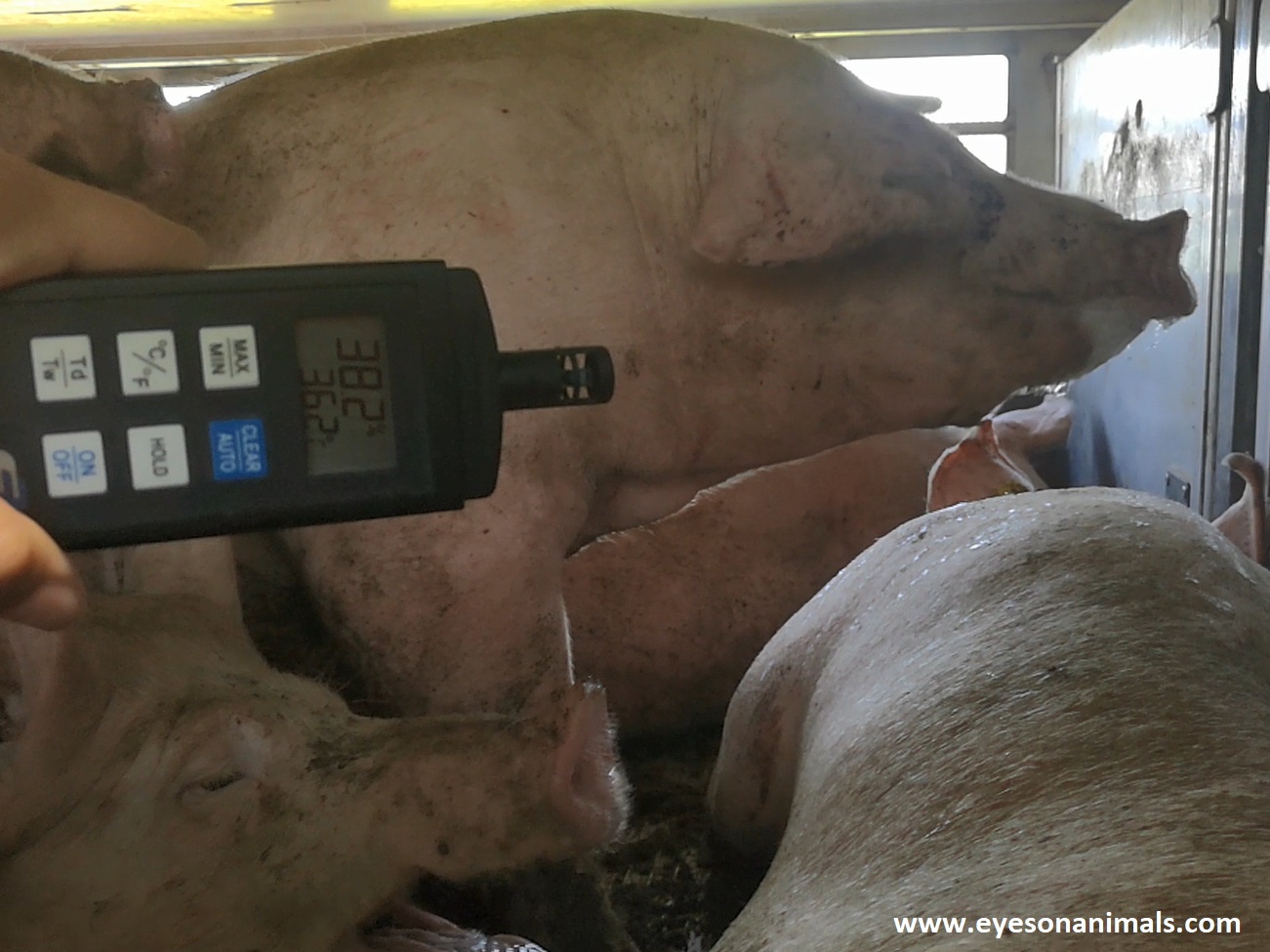
Pigs panting at high temperature


Nevertheless, Eyes on Animals believes this should be a requirement instead of a recommendation. We have made a small practical report for the industry which includes some very important steps that should be taken to reduce heat stress, for example: enlarging the lairage, increasing the number of loading ramps (so long waiting lines are prevented), using industrial fans and creating shaded areas for the trucks carrying animals. This report will soon be on our website.

At the beginning of 2019 a meeting will be held with the same stakeholders to provide an update on the improvements and developments to help reduce suffering during the summer months. 

  • teilen 
  • teilen 
  • teilen 
  • merken 
  • E-Mail 

Filed Under: Inspektionen, Transporte Tagged With: animal transport, animal welfare improvements, live animal transports, pig slaughterhouse

Primary Sidebar

Search

Featured

Regionale Schlachthöfe verschwinden – und die Tiere zahlen den Preis

In den gesamten Niederlanden verschwinden regionale Schlachthöfe in alarmierendem Tempo. Nicht, weil … [Read More...] about Regionale Schlachthöfe verschwinden – und die Tiere zahlen den Preis

Featured

Verletzte Sauen im Sammelzentrum Lunteren: NVWA-Untersuchung als unzureichend eingestuft

29. Januar 2026

Das niederländische Berufungsgericht für Handel und Industrie (College van Beroep voor het … [Read More...] about Verletzte Sauen im Sammelzentrum Lunteren: NVWA-Untersuchung als unzureichend eingestuft

Unser neuste Newsletter

Dear friends,

Last night, just before bed, my phone beeped with this message from a Dutch dairy farmer: “We immediately started keeping the calves with the cows after returning from your conference!”

Read more…

Erhalten Sie unseren englischen Newsletter

Subscribe

* indicates required

Eyes on Animals op X

eyes_on_animals Eyes on Animals @eyes_on_animals ·
14 Apr.

🐖 Eyes in Animals is ‘On the Road Again’. Following piglets, on the way to Croatia for slaughter. Poor animals… #pigs #Piglets #animaltransport

Auf Twitter antworten 2043973474914271353 Retweet auf Twitter 2043973474914271353 2 Auf Twitter liken 2043973474914271353 9 Twitter 2043973474914271353
eyes_on_animals Eyes on Animals @eyes_on_animals ·
12 Apr.

🇲🇳 EonA was invited to give a special presentation on farm-animal welfare at a conference in Mongolia. We talked about the importance of stunning prior to slaughter and what other measures can be taken to reduce suffering during transport. #animaltransport #slaughter #slacht

Auf Twitter antworten 2043302126089015442 Retweet auf Twitter 2043302126089015442 1 Auf Twitter liken 2043302126089015442 3 Twitter 2043302126089015442
philip_ciwf Philip Lymbery @philip_ciwf ·
11 Apr.

“There is no fundamental difference between man and animals in their ability to feel pleasure and pain, happiness, and misery”
Charles Darwin

#KindnessToAllKinds
#EndFactoryFarming
@CIWF_Global

Auf Twitter antworten 2042851254418694288 Retweet auf Twitter 2042851254418694288 429 Auf Twitter liken 2042851254418694288 1117 Twitter 2042851254418694288
Load More...

ANBI

Latest news

All Future Vision news

Footer

Donate with Paypal

Paypal Eyes on Animals
Beträge (einmalig):

Beträge (monatliche Spenden):

Lesestoff

  • In den Medien
  • Newsletters
  • Gesetzestexte
  • Spezialberichte
  • ANBI

Our Amsterdam Office

Amsterdam House Hotel
Das Büro von Eyes on Animals befindet sich im Amsterdam House Hotel direkt im Zentrum von Amsterdam. Die großzügige und warmherzige Hotelbetreiberin hat Eyes on Animals kostenfrei ein Zimmer zur Verfügung gestellt, in dem unsere Inspektoren arbeiten, Unterlagen unterbringen und Meetings abhalten können.

Copyright © 2026 · Eyes on Animals | Website by Webkompaan