• Skip to primary navigation
  • Skip to main content
  • Skip to primary sidebar
  • Skip to footer
  • EYES ON ANIMALS – Watching out for their Welfare
  • English
  • Dutch
  • German

Eyes on Animals

Watching out for their Welfare

  • Facebook
  • Instagram
  • Twitter
  • YouTube
DONATE SIGN-UP NEWSLETTER
  • About us
    • What we do
    • Our team
    • Key Figures
    • Our Vision
    • Contact
    • Make a donation
    • Newsletter
  • News
    • Latest news
    • Good news
    • Bad news
    • Featured news
    • Newsletter
  • Inspections
    • Farms
    • Markets
    • Transports
    • Slaughterhouses
    • Special projects
    • Other
  • Training
    • Police
    • Truck drivers
    • Poultry-catchers
    • Slaughter personnel
    • Training Material
    • Request a training
  • Education
  • Industry Tips
    • Animal transport
      • Cattle
      • Pigs
      • Poultry
    • Slaughterhouses
      • Cattle
      • Pigs
      • Poultry
      • Ritual slaughter
    • Educational videos
  • Publications
    • In the media
      • Print
      • Television
      • Radio
      • Videos
    • Newsletters
    • Special reports
    • Training Material
    • Annual reviews
  • Help us
Home » Our inspections » Visit to Van Rooi pig slaughterhouse in Helmond (NL) during heat

Visit to Van Rooi pig slaughterhouse in Helmond (NL) during heat

September 6, 2023

Today, we conducted an unannounced visit to Van Rooi pig slaughterhouse. We chose a later time in the afternoon (starting at 17:00) because the temperature was expected to rise as the day progressed. At Van Rooi, pigs are delivered until late in the evening (around 20:00). It was 32-33°C in the sun during our visit.

At Van Rooi, drivers who need to wait before unloading their pigs can park their trucks under a parking garage where there is shade. Additionally, on our advice, misting systems have been installed here. Under the parking garage, it is about 3 degrees cooler than outside, which makes a significant difference for the pigs. There is natural ventilation under the parking garage, and due to the large and high space, there is often a substantial breeze. However, we noticed that on days like today (outside temperature >32°C), this is no longer sufficient. We advised Van Rooi to acquire large mobile fans, and they will work on implementing this for next year.
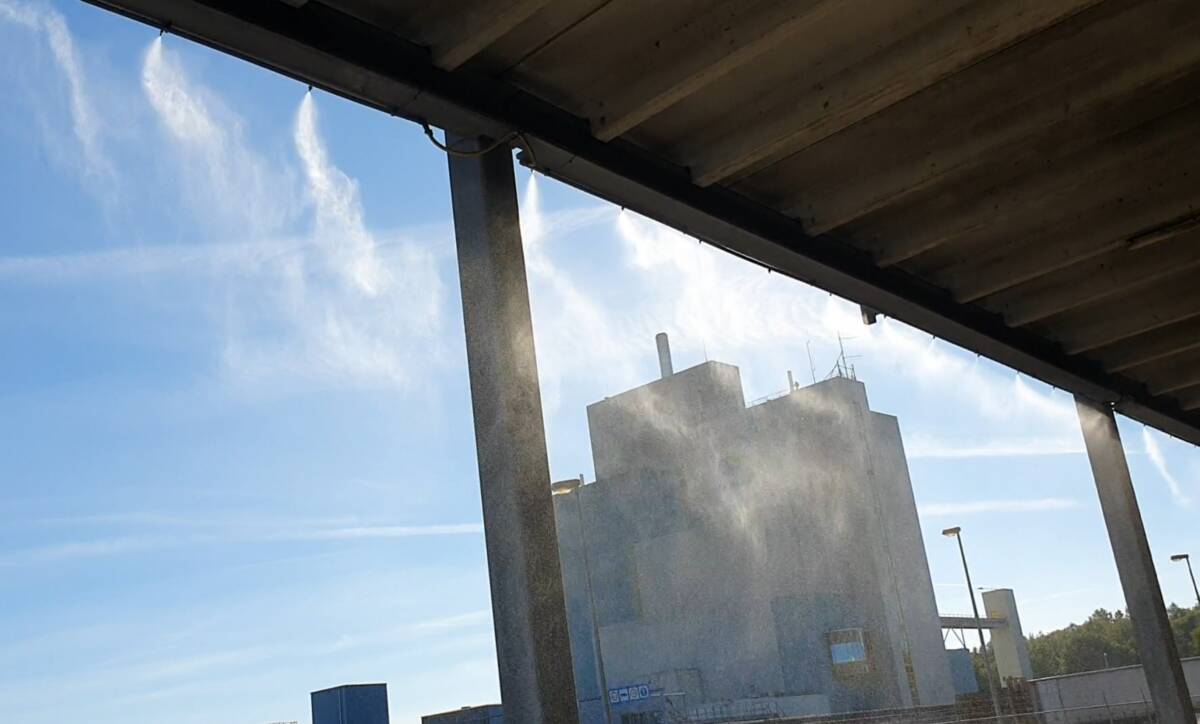
Water-misters underneath the parking garage of Van Rooi, where it is about 3°C cooler.

The waiting time at Van Rooi was considerably long today (> 1.5 hours). This was partly due to the fact that two trucks, in which the pigs experienced a lot of heat stress, were given priority to unload. It is important and positive that this happens, but at the same time, it means that other trucks have to wait longer. One of the two trucks that received priority had been stuck in traffic, and the pigs in this truck experienced a lot of heat stress. We informed Van Rooi that a driver who finds that their pigs are experiencing heat stress on a hot day while stuck in traffic can call the police. The police can then escort the truck past the traffic jam. We advised Van Rooi to make use of this and to avoid transporting pigs during hot weather when traffic jams are expected at certain times and locations.

Finally, we noticed that many pigs showed signs of heat stress upon arrival, such as rapid breathing with their mouths open (panting). On a day like today, it is simply not possible to prevent heat stress because the air circulating through the truck while it is in motion is also too warm. To prevent heat stress, we believe that transport should stop at temperatures > 25°C. 
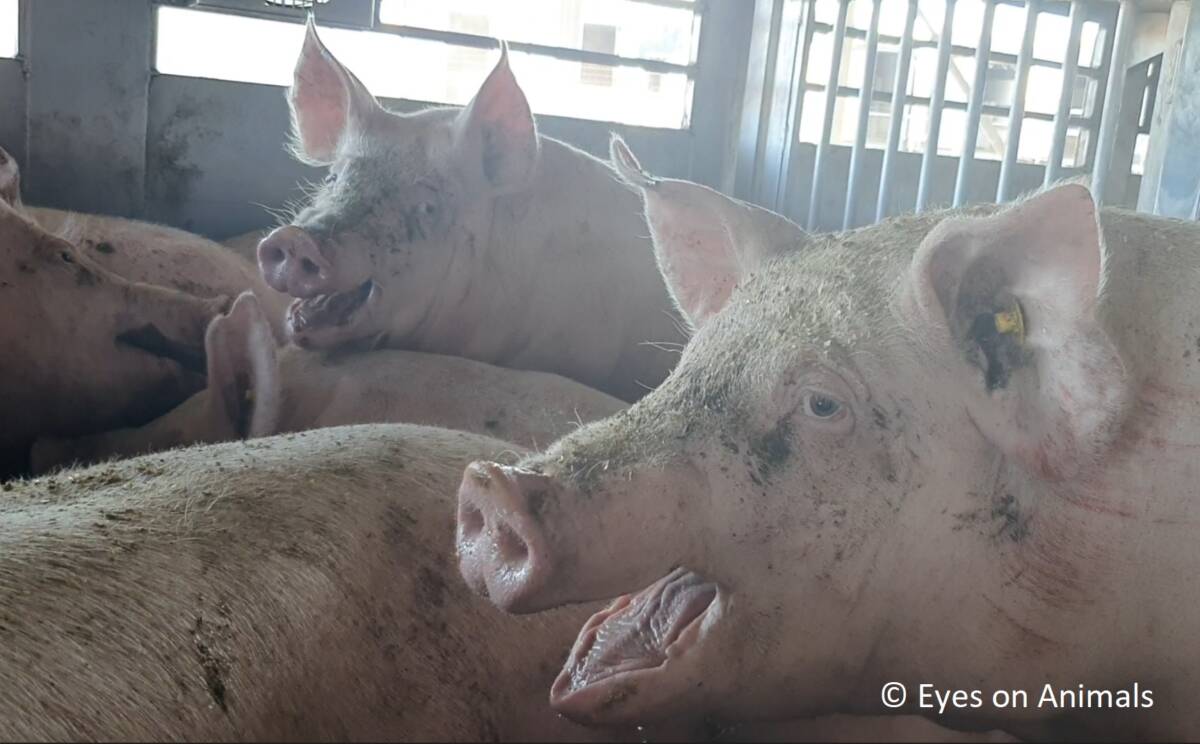
At arrival many pigs already showed signs of heat-stress

Furthermore, we still find the loading level of the heat protocol (10-20% fewer pigs) to be too high. Normally, 12-13 pigs are transported in one compartment, but today there were about 11 (according to the heat protocol). In our opinion, 10 pigs should be the maximum, so that pigs are not forced to lie against each other and can cool down better.
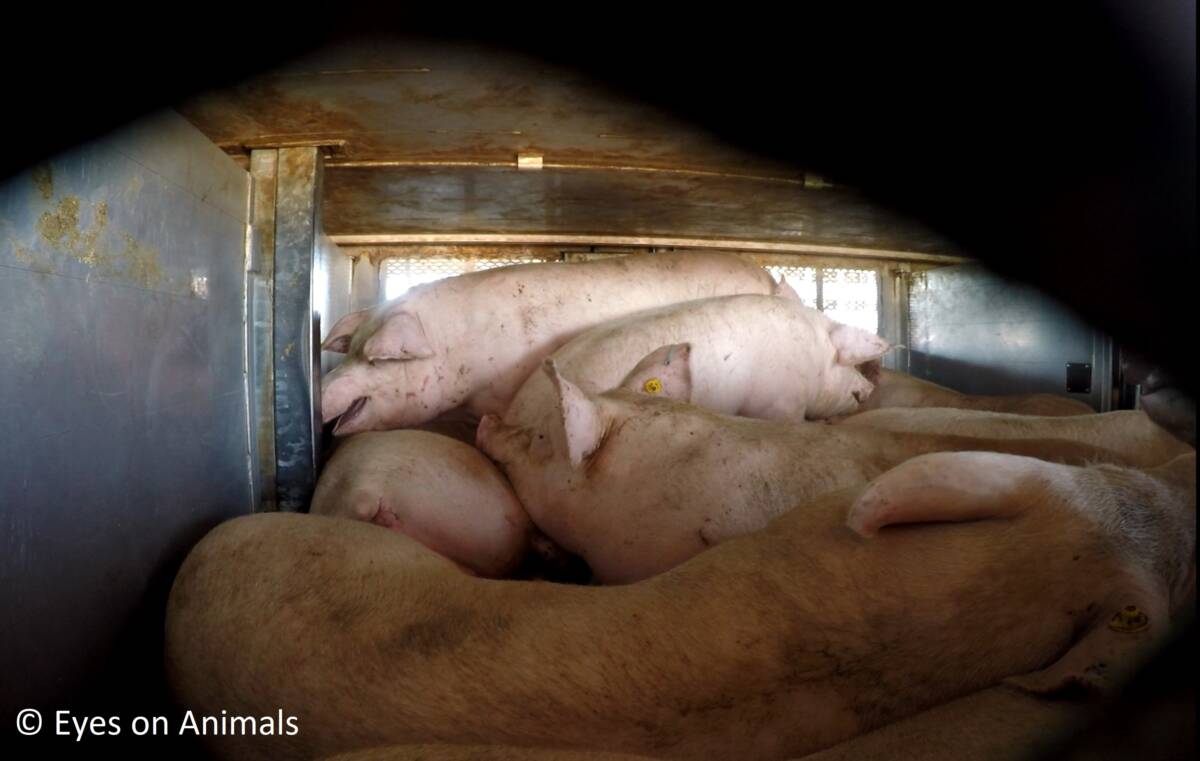
The loading density of the current heat protocol is too high: pigs are compelled to lie against or on top of each other, which prevents them from cooling adequately.

The degree of heat stress varied considerably from truck to truck. In all trucks, there was stress due to the heat, but sometimes it was mild, and sometimes it was severe. This will depend on factors such as the loading level, transport time, possible traffic jams, the equipment/design of the truck, the condition of the pigs, if social groups were mixed, the driving style of the chauffeur, and the handling of the pigs during loading. Temperatures in the trucks ranged from 30 to 36°C.

We would like to thank Van Rooi for giving us ample time to observe the pigs and take measurements. Van Rooi informed us that they would like to hear from us how they can better address hot days within their capabilities. We appreciate this positive attitude, and there will be a video-call soon about additional measures to address heat stress. We also want to thank the drivers at Van Rooi; all of them were so kind to speak with us and share with us their views and knowledge.


Filed Under: Our inspections, slaughterhouses Tagged With: animal transport, animal welfare inspection, slaughterhouses

Primary Sidebar

Search

Featured

Calf in truck

Press-release: NVWA takes action against Irish transporters leaving calves without milk for too long

The Netherlands Food and Consumer Product Safety Authority (NVWA) is taking enforcement action … [Read More...] about Press-release: NVWA takes action against Irish transporters leaving calves without milk for too long

Featured

Improving broiler catching and loading: Eyes on Animals presents to the Better Chicken Business Network

August 1, 2026

Weeks of good stockmanship can be undone in just a few hours of rough catching and loading. Catching … [Read More...] about Improving broiler catching and loading: Eyes on Animals presents to the Better Chicken Business Network

Our most recent newsletter

Dear friends,

After years of our fieldwork and our enforcement requests, the NVWA (the Dutch government inspection authority) is finally taking action.

The NVWA has made it clear to the entire calf export-import industry between Ireland and the Netherlands: transporting unweaned calves for more than 30 hours without milk will no longer be tolerated.

Read more…

Subscribe to our newsletter

Subscribe

* indicates required

Eyes on Animals op X

eyes_on_animals

Eyes on Animals

@eyes_on_animals ·
16h

🌈 Being queer is very normal and accepted amongst animals.
So Happy #ComingOutDay !

Queer Planet | Official Trailer | Peacock Original https://youtu.be/GikfSszcBHE?is=l0tECC2OerL-n7-Q via @YouTube

Reply on Twitter 2109253155183608135 Retweet on Twitter 2109253155183608135 Like on Twitter 2109253155183608135 2 Twitter 2109253155183608135
eyes_on_animals

Eyes on Animals

@eyes_on_animals ·
10 Oct

🔥🐓 18.000 kippen omgekomen bij stalbrand.
Arme dieren.https://www.omroepzeeland.nl/nieuws/18849505/18000-kippen-omgekomen-bij-grote-brand-in-kippenschuur-bij-biervliet #kippen #stalbrand

Reply on Twitter 2109024590941114832 Retweet on Twitter 2109024590941114832 6 Like on Twitter 2109024590941114832 11 Twitter 2109024590941114832
faunabeschermin

De Faunabescherming

@faunabeschermin ·
8 Oct

🕊️ @LucZeebroek @nrc

Reply on Twitter 2108289844937924635 Retweet on Twitter 2108289844937924635 6 Like on Twitter 2108289844937924635 27 Twitter 2108289844937924635

Footer

Donate with Paypal

Paypal Eyes on Animals
One-time donation:
Monthly donation:

Reading Material

  • In the Media
  • Newsletters
  • Special EonA reports
  • Legislative texts
  • ANBI

ANBI

Our Amsterdam Office

Amsterdam House Hotel
Eyes on Animals main office is in downtown Amsterdam, at the Amsterdam House Hotel. The generous and warm-hearted hotel owner donated to Eyes on Animals, free of charge, a beautiful room where our inspectors can work, hold meetings and store their material.

Copyright © 2026 · Eyes on Animals | Website by Webkompaan