• Skip to primary navigation
  • Skip to main content
  • Skip to primary sidebar
  • Skip to footer
  • EYES ON ANIMALS – Watching out for their Welfare
  • English
  • Dutch
  • German

Eyes on Animals

Watching out for their Welfare

  • Facebook
  • Instagram
  • Twitter
  • YouTube
DONATE SIGN-UP NEWSLETTER
  • About us
    • What we do
    • Our team
    • Key Figures
    • Our Vision
    • Contact
    • Make a donation
    • Newsletter
  • News
    • Latest news
    • Good news
    • Bad news
    • Featured news
    • Newsletter
  • Inspections
    • Farms
    • Markets
    • Transports
    • Slaughterhouses
    • Special projects
    • Other
  • Training
    • Police
    • Truck drivers
    • Poultry-catchers
    • Slaughter personnel
    • Training Material
    • Request a training
  • Education
  • Industry Tips
    • Animal transport
      • Cattle
      • Pigs
      • Poultry
    • Slaughterhouses
      • Cattle
      • Pigs
      • Poultry
      • Ritual slaughter
    • Educational videos
  • Publications
    • In the media
      • Print
      • Television
      • Radio
      • Videos
    • Newsletters
    • Special reports
    • Training Material
    • Annual reviews
  • Help us
Home » Our inspections » Unannounced visit to Gosschalk slaughterhouse in Epe (NL)

Unannounced visit to Gosschalk slaughterhouse in Epe (NL)

July 25, 2022

Today we visited Gosschalk in Epe (NL) where Eyes on Animals has permission to inspect without notice. Due to the vacation period there were relatively few people present and fewer pigs being slaughtered but the staff still made time for us immediately. 
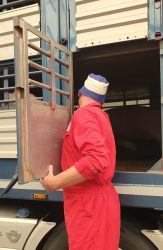
Using the side-door to move pigs out reduces stress

First, we looked at footage from the smart-camera system, ‘Argus’, taken on a sweltering day the week before. We wanted to observe how the pigs arrived that day. We also looked at random images from other areas of the slaughterhouse including pigs and bovine. Secondly we carried out physical checks where we observed the offloading, handling and electrical stunning of the pigs. During offloading the pigs were given time. The driver only used plastic bags as driving tools, which kept the noise to a minimum. This is positive. In general, there is often quite a lot of stress when drivers enter the trailer-compartments to get the pigs out. Pig often fear humans; as soon they are approached they will attempt to escape. Those at the back of the compartments will often jump onto each other as a result. During our presence we saw one driver using the side-door of a truck compartment, to move the pigs out, instead of entering it. This caused a lot less stress amongst the pigs. This is one reason why EonA is in favor of more side doors. 
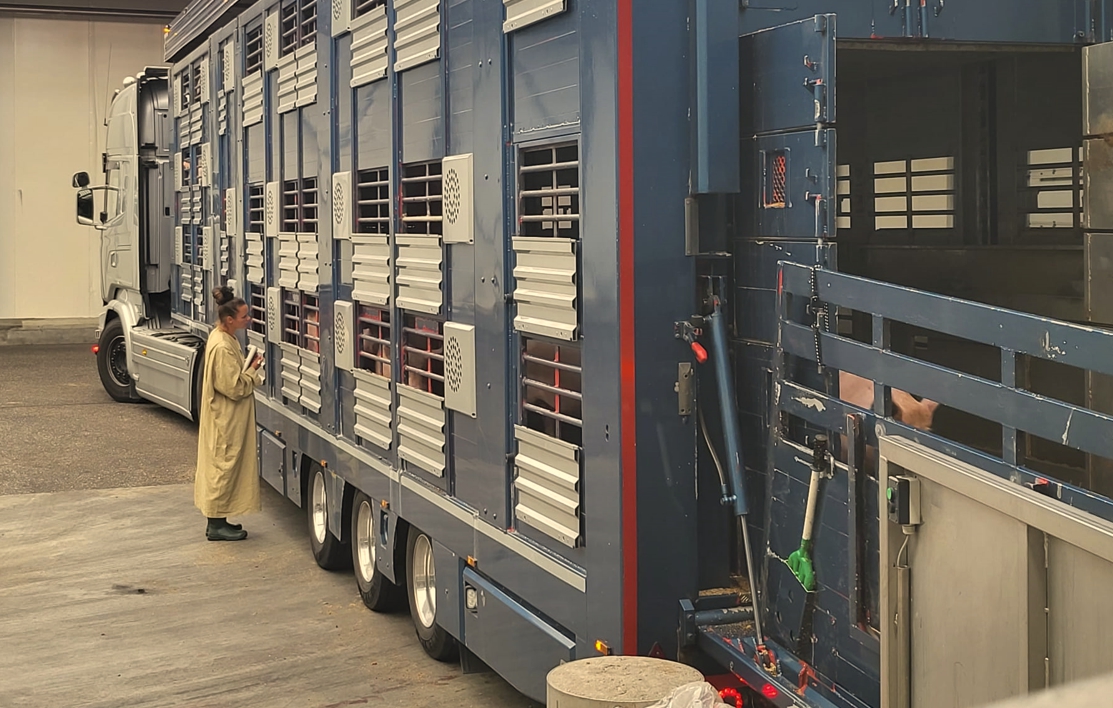
Eyes on Animals inspecting the offloading of pigs

Moving the pigs towards the stunner was done calmly. Staff only used quiet handling tools, such as plastic bags. The stress levels were much lower than seen in other slaughterhouses using electricity and high slaughter speed (>350 per hour). It made a big difference that fewer pigs were slaughtered today (approx. 350 instead of 450 pigs per hour) – this provides more time meaning the animals can be treated with more patience. There was also more space in the waiting pens. We noticed on the images and during the physical checks that sometimes rather large groups are being driven (15-20 pigs). To reduce the stress level, we advised smaller groups (6-7 pigs), as is also recommended by Temple Grandin. Gosschalk is already experimenting with this. 

Although it was not as warm today (approx. 25 degrees) as it was last week, we still witnessed several pigs at the rear of the trucks and in the waiting pen  showing signs of heat stress. We are told extra fans will be installed to prevent this soon. It was difficult to determine from the camera footage if the pigs experienced heat stress during unloading last week – to know, we need larger images (full screen) so you can zoom in . Also, the cameras do not record sound which makes it hard to recognize signs of stress caused by heat or other factors. However, with the help of the Argus system we were able to see exactly how many pigs had to be stunned immediately upon arrival (for animal welfare reasons) and there were a few. The correct actions were taken in these cases. 

Lastly, we were concerned about the condition of a few cows. We will speak with Gosschalk about following a stricter receiving policy to ensure that livestock farmers and drivers don’t take the unnecessary risk of delivering animals in this condition, instead they should put them out of their suffering at the farm.

All-in all we got a positive impression. The handling of the pigs was calm, the noise level is much lower compared to our first visit, injured or sick animals were put down immediately to prevent further suffering and the Argus smart camera system is an important and very helpful tool to monitor welfare. 

We want to thank Gosschalk for their transparency and efforts to improve animal welfare.

Filed Under: Our inspections, slaughterhouses Tagged With: animal welfare improvements, slaughterhouse design, slaughterhouses

Primary Sidebar

Search

Featured

Calf in truck

Press-release: NVWA takes action against Irish transporters leaving calves without milk for too long

The Netherlands Food and Consumer Product Safety Authority (NVWA) is taking enforcement action … [Read More...] about Press-release: NVWA takes action against Irish transporters leaving calves without milk for too long

Featured

Improving broiler catching and loading: Eyes on Animals presents to the Better Chicken Business Network

August 1, 2026

Weeks of good stockmanship can be undone in just a few hours of rough catching and loading. Catching … [Read More...] about Improving broiler catching and loading: Eyes on Animals presents to the Better Chicken Business Network

Our most recent newsletter

Dear friends,

After years of our fieldwork and our enforcement requests, the NVWA (the Dutch government inspection authority) is finally taking action.

The NVWA has made it clear to the entire calf export-import industry between Ireland and the Netherlands: transporting unweaned calves for more than 30 hours without milk will no longer be tolerated.

Read more…

Subscribe to our newsletter

Subscribe

* indicates required

Eyes on Animals op X

eyes_on_animals

Eyes on Animals

@eyes_on_animals ·
11 Oct

🌈 Being queer is very normal and accepted amongst animals.
So Happy #ComingOutDay !

Queer Planet | Official Trailer | Peacock Original https://youtu.be/GikfSszcBHE?is=l0tECC2OerL-n7-Q via @YouTube

Reply on Twitter 2109253155183608135 Retweet on Twitter 2109253155183608135 1 Like on Twitter 2109253155183608135 2 Twitter 2109253155183608135
eyes_on_animals

Eyes on Animals

@eyes_on_animals ·
10 Oct

🔥🐓 18.000 kippen omgekomen bij stalbrand.
Arme dieren.https://www.omroepzeeland.nl/nieuws/18849505/18000-kippen-omgekomen-bij-grote-brand-in-kippenschuur-bij-biervliet #kippen #stalbrand

Reply on Twitter 2109024590941114832 Retweet on Twitter 2109024590941114832 6 Like on Twitter 2109024590941114832 11 Twitter 2109024590941114832
faunabeschermin

De Faunabescherming

@faunabeschermin ·
8 Oct

🕊️ @LucZeebroek @nrc

Reply on Twitter 2108289844937924635 Retweet on Twitter 2108289844937924635 6 Like on Twitter 2108289844937924635 27 Twitter 2108289844937924635

Footer

Donate with Paypal

Paypal Eyes on Animals
One-time donation:
Monthly donation:

Reading Material

  • In the Media
  • Newsletters
  • Special EonA reports
  • Legislative texts
  • ANBI

ANBI

Our Amsterdam Office

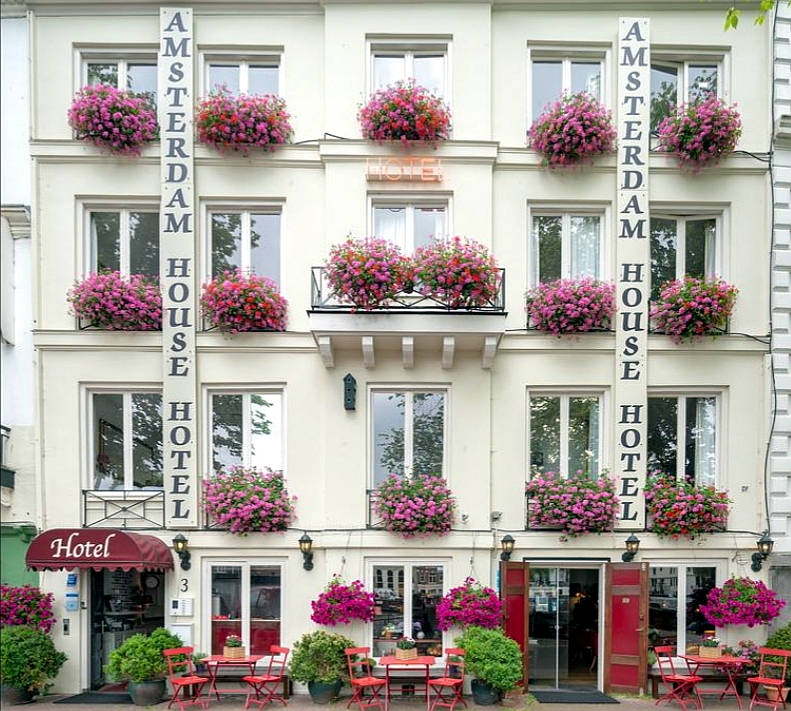
Amsterdam House Hotel
Eyes on Animals main office is in downtown Amsterdam, at the Amsterdam House Hotel. The generous and warm-hearted hotel owner donated to Eyes on Animals, free of charge, a beautiful room where our inspectors can work, hold meetings and store their material.

Copyright © 2026 · Eyes on Animals | Website by Webkompaan