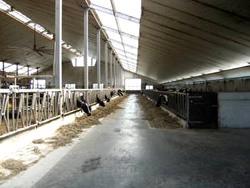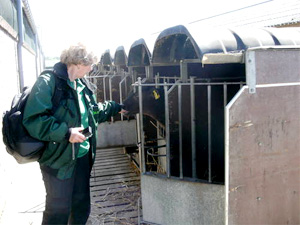
Today Eyes on Animals visited a dairy farm in the province Limburg. This family business houses 150 milk cows (Holsteins) and 135 calves. Annually, each milk cow gives approximately 9000 litres of milk.
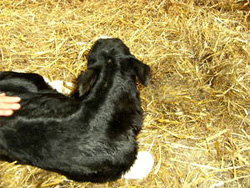 At the age of 14 months, the cows are inseminated for the first time. The cows are thus two years old when they give birth to their first calf. The calf is allowed to stay up to 8 hours with its mother, to receive the necessary colostrum. After just 8 hrs, the calf is separated from its mother and moved to a so-called ‘baby crib’. This is an individual outdoor hutch with a roof and some straw. The calves are always moved outside, regardless if it is summer or winter. The mother cow stays roughly 3 days at the same place as where she gave birth.
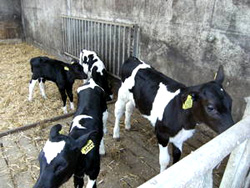
The little bulls stay about 10 days outside in the so-called baby crib’. After this period, they are transported elsewhere to be fattened. The little heifers on the other hand are moved to group housing, where they stay together with 2 or 3 other calves. (Compared to the biological dairy which we visited earlier this year, this period is much shorter: on the biological dairy farm the heifers were kept in single pens for 2 weeks).
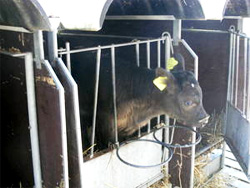 The earmarks are applied within 4 days. After 3 weeks the veterinarian dehorns the calves, under local anaesthetic . The calves can suffer from pain afterwards, which is noticeable because they don’t want to place their head through the bars to drink. Calves aren’t given any medication to ease this post-pain.
 On average, a cow gives birth to 4 calves and at the age of 6 or 7 year, she is then transported to a slaughterhouse. At this particular farm, the cows don’t have any possibility to the outdoors or to grazing. The reason for this is the little amount of land that the farmer owns. The fields are used to produce feed for the cows. When the farmer was asked by us if he would like to let his cows go outdoors if he had more space, he responded yes. But, as long as consumers demand really cheap milk, cows will not have access to the outdoors.
Eyes on Animals thanks this dairy farmer for the tour of his farm.