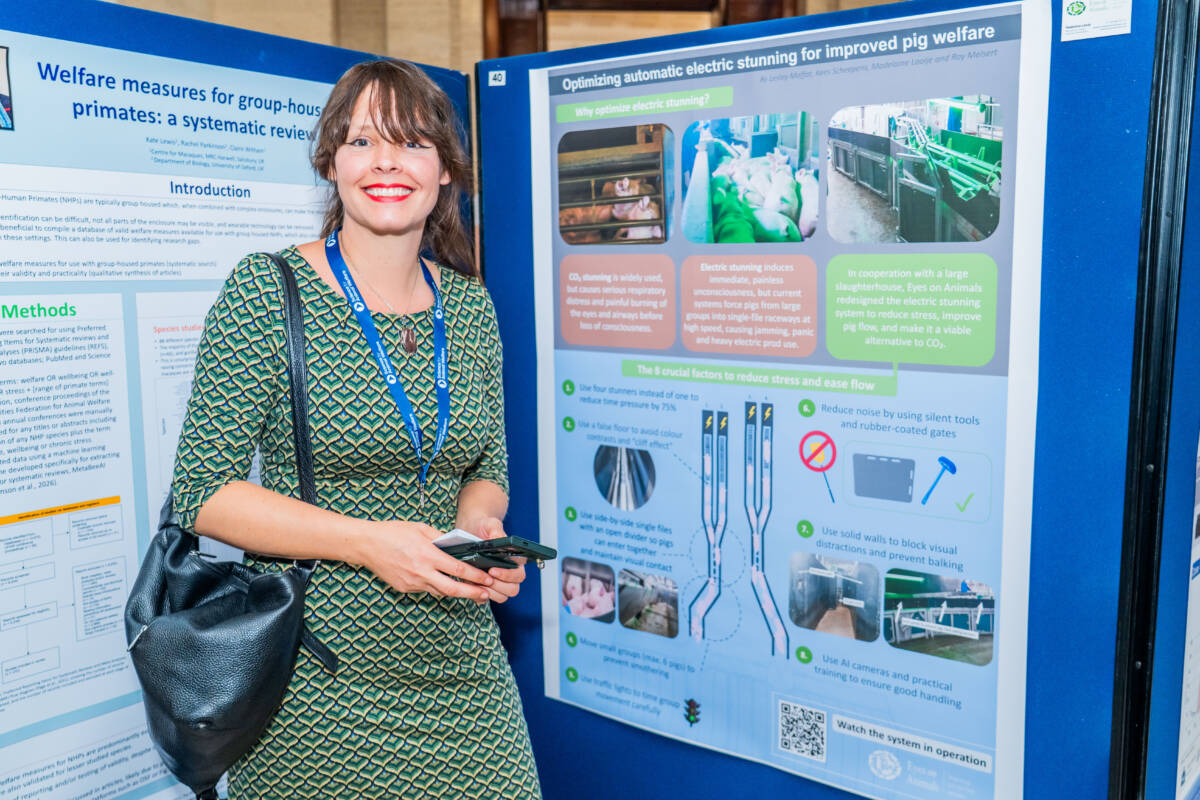
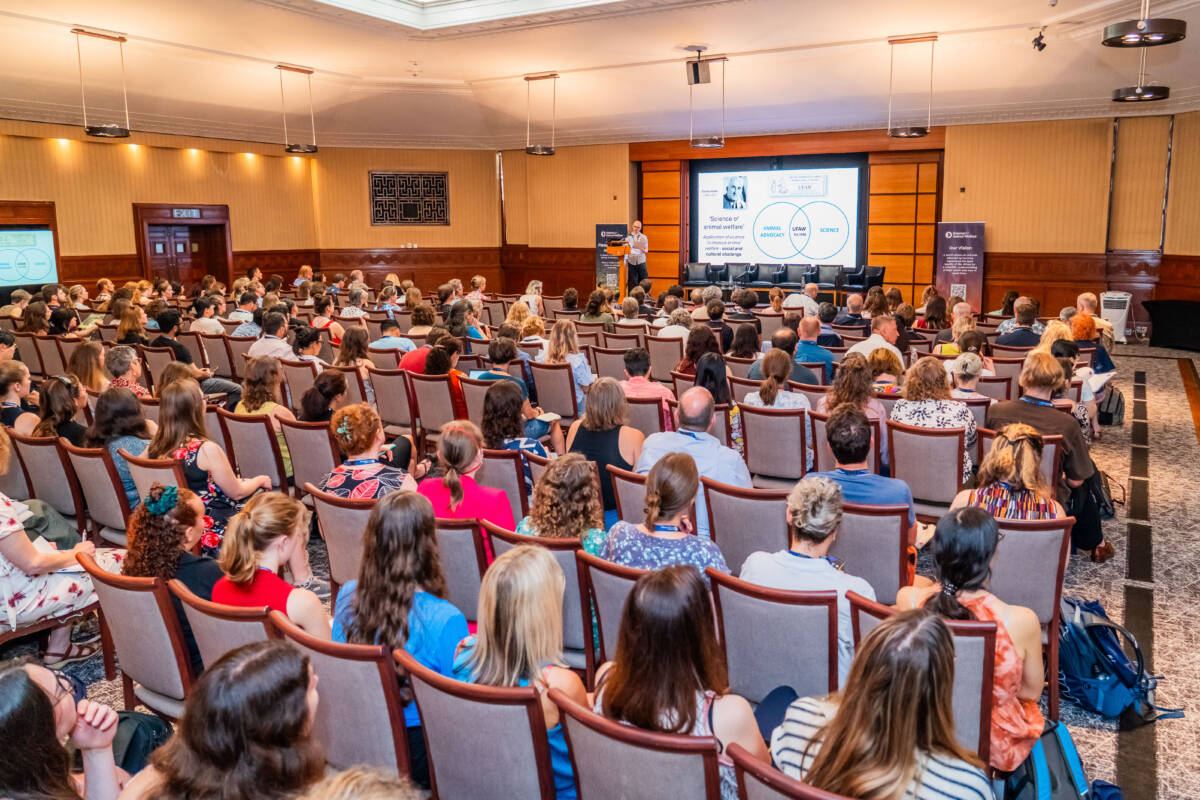
This week, Eyes on Animals took part in the Science for Animal Welfare Conference (formerly UFAW) in London, where we presented a poster showcasing how an existing automatic electrical stunning system was redesigned to provide a commercially viable and more humane alternative to CO₂ stunning.
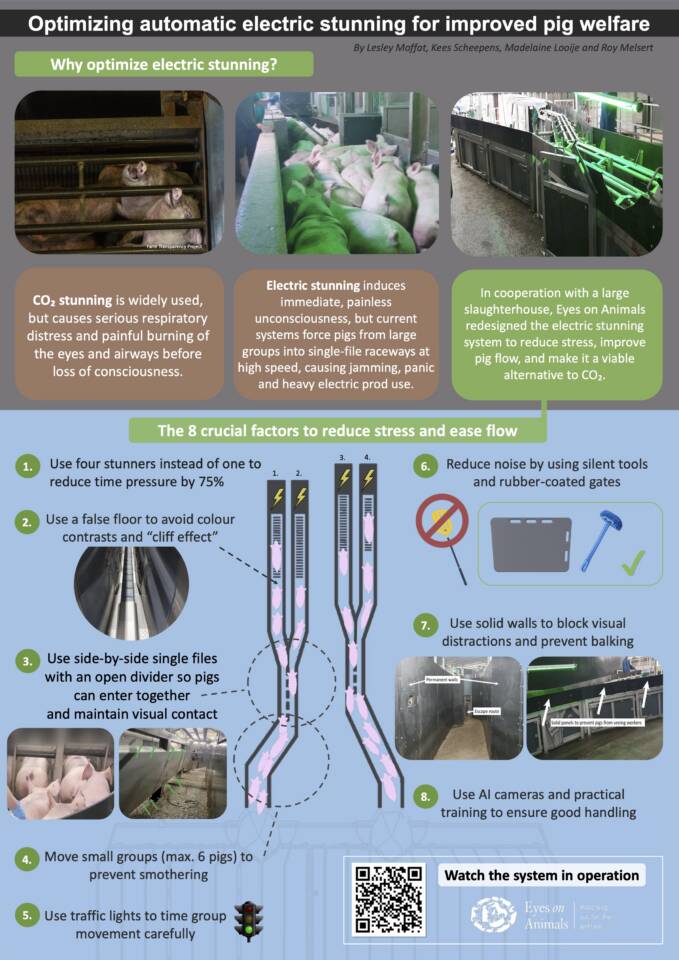
Together with a major pig slaughterhouse, Eyes on Animals redesigned and optimized an automatic electrical stunning system to improve both animal welfare and practicality. The system was adapted to reduce stress in pigs before stunning by, among other things, minimizing distractions, installing a false floor in the restrainer, moving only small groups of pigs at a time, and replacing the original single-file raceway with four single-file raceways arranged as two parallel pairs with see-through dividers between them, allowing pigs to remain alongside and in sight of each other. This redesign substantially reduced pressure on the pigs during herding and the workload for staff, while maintaining slaughter line speed. We hope this demonstrates that the redesigned system can be implemented successfully on a commercial scale, helping the sector move away from CO₂ stunning.
The conference brought together scientists, veterinarians and animal welfare experts from around the world to discuss the latest scientific developments and research findings in animal welfare. During the discussions, CO₂ stunning of pigs repeatedly emerged as one of the most important unresolved animal welfare challenges in Europe.
Every year, millions of pigs are still stunned using high concentrations of carbon dioxide. Scientific research has shown that pigs experience severe respiratory distress and intense pain in their eyes and airways before they lose consciousness. Finding a practical alternative is therefore one of the most urgent animal welfare priorities for the pig sector.
We hope this project will encourage further development and wider adoption of improved automatic electrical stunning systems, bringing the pig industry one step closer to phasing out CO₂ stunning altogether.
Special thanks to the Barth-Misset Fund for funding our efforts to help this improved stunning system reach more slaughterhouses, researchers and policymakers, bringing the phase-out of CO₂ stunning one step closer.