• Skip to primary navigation
  • Skip to main content
  • Skip to primary sidebar
  • Skip to footer
  • EYES ON ANIMALS – Watching out for their Welfare
  • English
  • Dutch
  • German

Eyes on Animals

Watching out for their Welfare

  • Facebook
  • Instagram
  • Twitter
  • YouTube
DONATE SIGN-UP NEWSLETTER
  • About us
    • What we do
    • Our team
    • Key Figures
    • Our Vision
    • Contact
    • Make a donation
    • Newsletter
  • News
    • Latest news
    • Good news
    • Bad news
    • Featured news
    • Newsletter
  • Inspections
    • Farms
    • Markets
    • Transports
    • Slaughterhouses
    • Special projects
    • Other
  • Training
    • Police
    • Truck drivers
    • Poultry-catchers
    • Slaughter personnel
    • Training Material
    • Request a training
  • Education
  • Industry Tips
    • Animal transport
      • Cattle
      • Pigs
      • Poultry
    • Slaughterhouses
      • Cattle
      • Pigs
      • Poultry
      • Ritual slaughter
    • Educational videos
  • Publications
    • In the media
      • Print
      • Television
      • Radio
      • Videos
    • Newsletters
    • Special reports
    • Training Material
    • Annual reviews
  • Help us
Home » Our training » Calmer chicken catching: Eyes on Animals shares field experience with EU inspectors

Calmer chicken catching: Eyes on Animals shares field experience with EU inspectors

September 30, 2026

Today we presented our experience with catching chickens to the animal welfare inspection authorities of all EU Member States. We spoke at the annual meeting of the EU network EURCAW-Poultry-SFA.

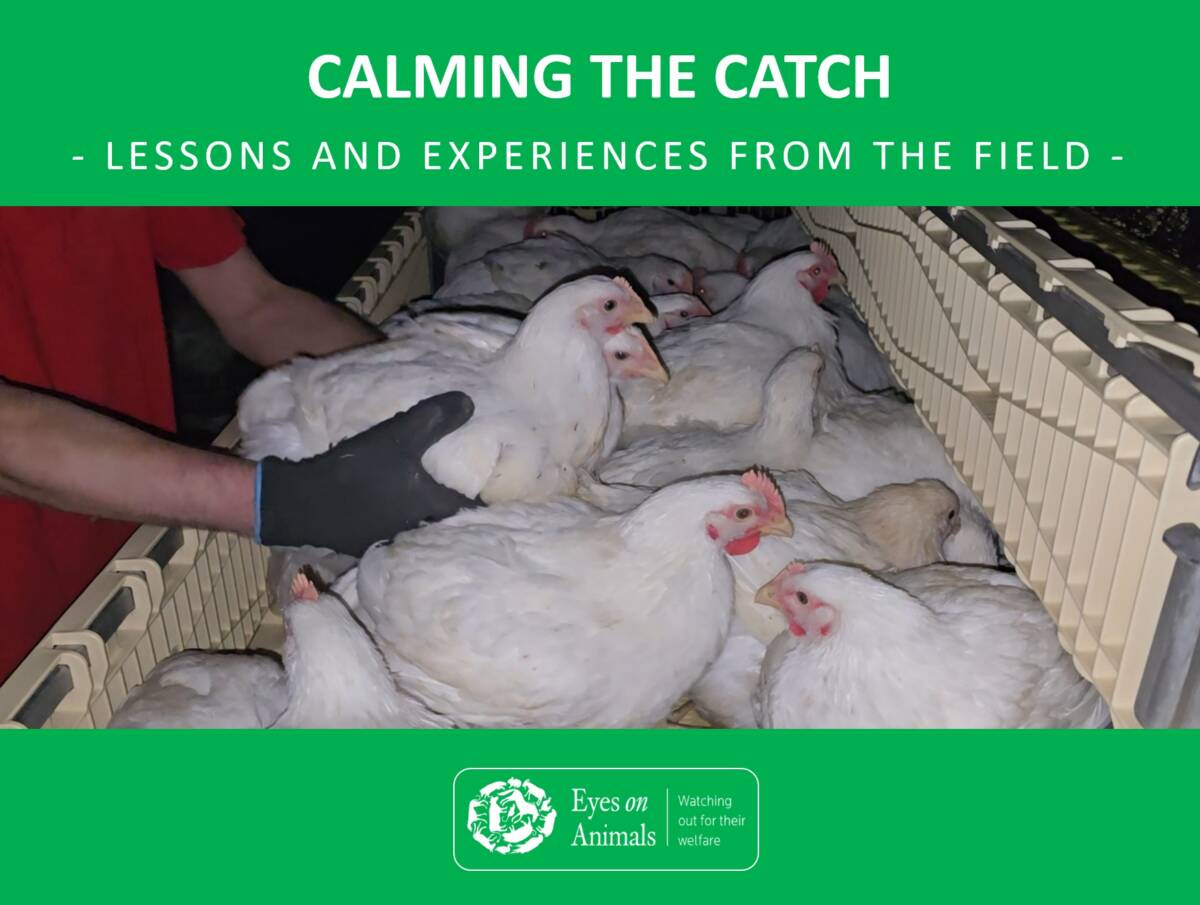
Chickens are still commonly caught upside down, by one leg, with three to six birds held at a time. This method causes panic, wing flapping and attempts to escape, which often lead to collisions with housing equipment, crates or containers. In 2017, Eyes on Animals introduced upright catching. With this method, chickens are held in a natural, upright position and handled more calmly. Research by Wageningen University & Research, ILVO and others shows that birds caught upright experience less stress and suffer fewer injuries. Upright catching is now used on a growing number of farms, including all biodynamic (Demeter) laying hen farms and all Kipster farms. See the full list here >>

Upright catching is already standard in many countries

Upright catching is already common in large parts of the world. In Brazil, the world’s largest exporter of chicken meat, and in Colombia, most broilers are caught upright because of meat quality reasons. In Thailand, the Chaveevan Group, a major chicken meat producer, also catches upright. And in Switzerland it has been standard practice for more than fifteen years.

More than the catching method alone
But the catching method is not the only thing that affects animal welfare. We are also calling for:

  • Better transport containers, crates and housing systems, to reduce catching injuries and to ease fatigue and frustration among catchers. Container drawers, for example, often lack enough head height, so birds hit the edges more often. Catchers also often have to lift too high, because containers can be up to five drawers tall. In addition, aviary systems are often poorly suited to catching: they are too high and too deep, and full of obstacles.
  • Less pressure from slaughterhouses and transporters to catch quickly. People need time to handle animals with care! Several studies show that faster catching leads to more injuries.

Catching machines: opportunities and challenges
In the Netherlands, a court has ruled that, from 2027, the Dutch Food and Consumer Product Safety Authority (NVWA) must take enforcement action when chickens are caught by their legs. This means the sector must switch to other methods: catching upright by hand, or using catching machines. Since the ruling, demand for catching machines has risen sharply. Machines offer opportunities because fewer catchers are needed. The catchers who are no longer needed can be deployed to catch laying hens by hand, since no machines exist yet for laying hens. But machines can also bring challenges. Operators must be very well trained, belt speeds must not be set too high, and container drawers must be properly matched to the machine to avoid flapping, collisions and injuries.

The time is now
The EU animal welfare rules on transport are currently being revised. As early as 1995, the Council of Europe recommended that poultry should not be carried upside down and should be better protected against catching injuries. Now, 31 years later, it is time to put those recommendations into practice. We hope our field experience can help make that happen.

We would like to thank EURCAW-Poultry-SFA for the invitation and the opportunity to share our experience.
Filed Under: Our training, Poultry-catchers

Primary Sidebar

Search

Featured

Calf in truck

Press-release: NVWA takes action against Irish transporters leaving calves without milk for too long

The Netherlands Food and Consumer Product Safety Authority (NVWA) is taking enforcement action … [Read More...] about Press-release: NVWA takes action against Irish transporters leaving calves without milk for too long

Featured

Improving broiler catching and loading: Eyes on Animals presents to the Better Chicken Business Network

August 1, 2026

Weeks of good stockmanship can be undone in just a few hours of rough catching and loading. Catching … [Read More...] about Improving broiler catching and loading: Eyes on Animals presents to the Better Chicken Business Network

Our most recent newsletter

Dear friends,

After years of our fieldwork and our enforcement requests, the NVWA (the Dutch government inspection authority) is finally taking action.

The NVWA has made it clear to the entire calf export-import industry between Ireland and the Netherlands: transporting unweaned calves for more than 30 hours without milk will no longer be tolerated.

Read more…

Subscribe to our newsletter

Subscribe

* indicates required

Eyes on Animals op X

nickottens

Nick Ottens

@nickottens ·
4 Oct

8 op de 10 Nederlanders willen het onverdoofd slachten van dieren verbieden, bleek vorig jaar uit een peiling van @dierencoalitie en @Dierbescherming. PRO, VVD en @stasLVVN willen dat ook. Ik hoop dat het er dit jaar van komt! 🤞
Meer in mijn nieuwsbrief: https://www.nickottens.nl/p/verbod-op-rituele-slacht-lijkt-er

Reply on Twitter 2106723136364499118 Retweet on Twitter 2106723136364499118 1 Like on Twitter 2106723136364499118 1 Twitter 2106723136364499118
vvd

VVD

Verified account @vvd ·
4 Oct

"Als je ziet dat wij proberen het dierenwelzijn in Nederland te verbeteren, dan is het onverdoofd slachten toestaan wel heel wrang."

Staatssecretaris @SilvioErkens wil dierenleed voorkomen. Daarom wil hij af van de uitzondering die onverdoofd ritueel slachten mogelijk maakt. 👇

Reply on Twitter 2106634680791351408 Retweet on Twitter 2106634680791351408 55 Like on Twitter 2106634680791351408 318 Twitter 2106634680791351408
foodlog_nl

foodlog.nl

@foodlog_nl ·
2 Oct

Foto van levend dier op het menu geeft vega-verkoop flinke boost #vleesconsumptie #vegetarisch #nudging #eiwittransitie #consumentengedrag

Reply on Twitter 2105921225469866209 Retweet on Twitter 2105921225469866209 1 Like on Twitter 2105921225469866209 Twitter 2105921225469866209

Footer

Donate with Paypal

Paypal Eyes on Animals
One-time donation:
Monthly donation:

Reading Material

  • In the Media
  • Newsletters
  • Special EonA reports
  • Legislative texts
  • ANBI

ANBI

Our Amsterdam Office

Amsterdam House Hotel
Eyes on Animals main office is in downtown Amsterdam, at the Amsterdam House Hotel. The generous and warm-hearted hotel owner donated to Eyes on Animals, free of charge, a beautiful room where our inspectors can work, hold meetings and store their material.

Copyright © 2026 · Eyes on Animals | Website by Webkompaan