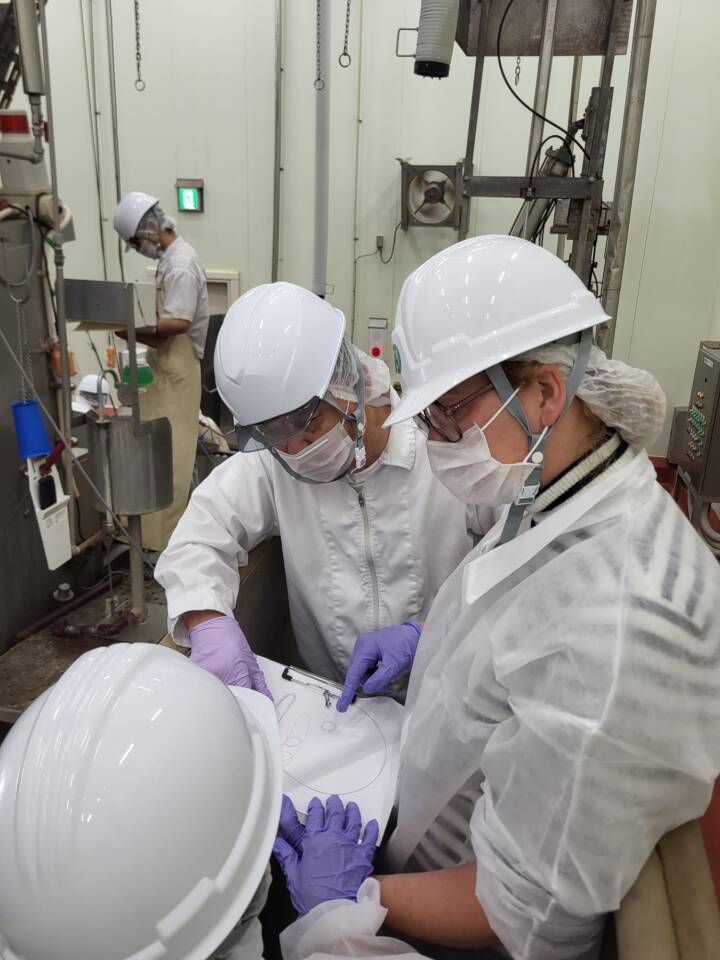
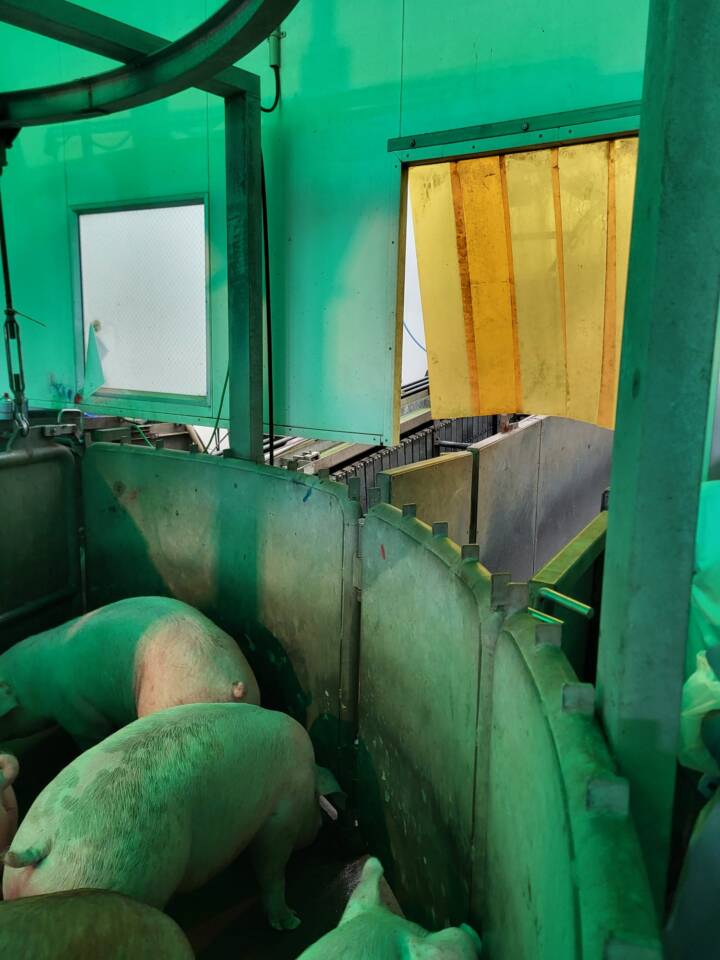
At the slaughterhouse today, as part of our welfare-mission with JAMTI, 200 pigs per hour are slaughtered. What was new to us was seeing pigs moved towards the automatic restraint for stunning by a moving floor and moving side walls, without any need for electric stimulation. This was very positive. Some equipment details posed injury risks, but rubber protection and fine-tuning could reduce them.
What really stood out was the calm pace. The slaughterhouses we’ve visited here don’t have the frantic atmosphere we’ve encountered in many other countries. Workers didn’t seem stressed: no shouting, running back and forth or rushing the animals. This makes an enormous difference. Constant time pressure and hurried handling can turn an already unfamiliar situation into sheer terror for animals, while also leaving workers frustrated and impatient.
We saw no electric goads. Staff used a light handling stick with soft plastic strips at the end to attract the pigs’ attention and guide them. We witnessed no hitting, rough handling or shouting at the animals.
There was, however, a serious concern about animals unable to walk. We saw two pigs separated into sick pens: one in shock and recovering from transport stress; the other unable to use her hind legs, moving only with her front legs. Staff confirmed that such animals are moved to the normal slaughter area, sometimes by lifting and supporting them or pulling them with a chain and pulley. We observed the pulley and chain, but we did not witness this movement ourselves.
These animals need emergency stunning and killing where they lie, sparing them further pain and distress. Non-ambulatory animals or animals showing any serious pain should never be forced to move but rather put outnofntheir.misery immediately. This is a priority we want to work on together with the manager but also the Japanese industry and authorities, as it is common practice across the country.
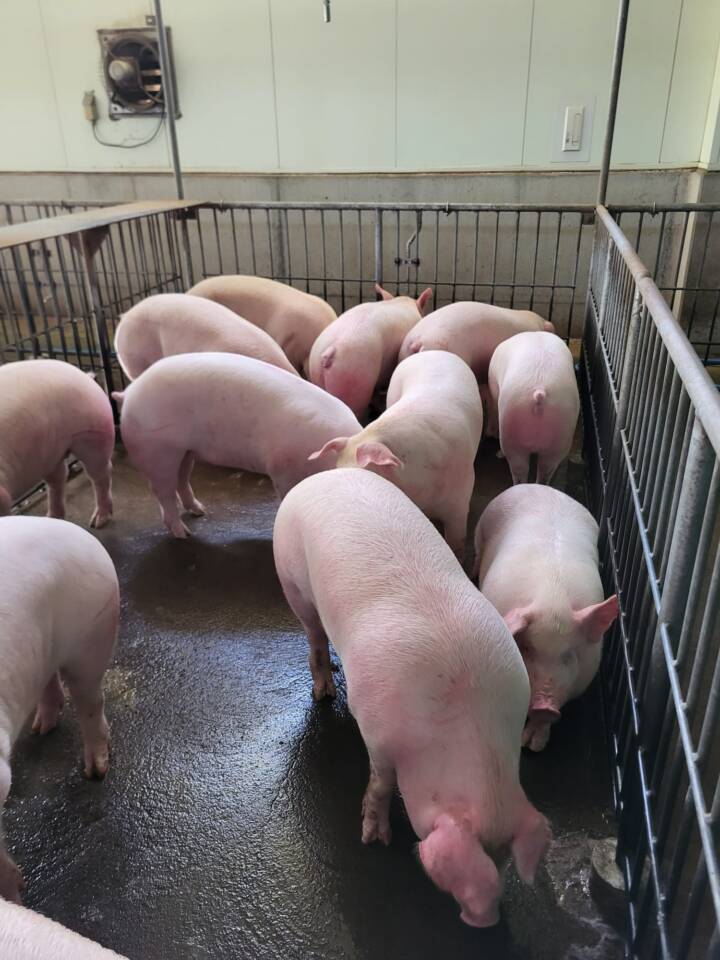
The lairage had very good air quality, drinking nipples throughout, and clean, dry floors. Some pens were overcrowded because each producer’s pigs were assigned to a fixed-size pen. We suggested adjustable partitions to match pen size to the number of pigs arriving.
Fortunately, most Japanese pig slaughterhouses still use electric stunning rather than the painful CO₂ gas common in other Western countries. We learned that pressure to switch has partly come from European and North American export markets, where CO₂ was long promoted as the modern approach. Now the UK is consulting on a ban of CO2 because of the suffering it causes, and European efforts are encouraging alternatives too. It is a valuable moment to help Japanese plants improve extract the full potential of their electric systems, also to set a good example for the rest of the western world.
The managers were incredibly welcoming and attentive to our suggestions and JAMTI was a great host. That openness gives us a good basis for making fast, real concrete improvements together to benefit animals.